GeForce RTX 4090 D DLSS 4.5 vs DLSS 5: baseline and outlook

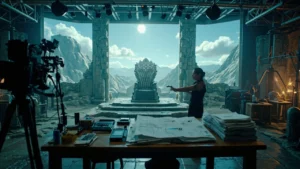
Official DLSS 5 Zorah comparison frame. Image credit: NVIDIA.
GeForce RTX 4090 D DLSS 4.5 vs DLSS 5: the real status for game developers
The RTX 4090 D still runs DLSS 4.5 Super Resolution, Ray Reconstruction, and Frame Generation in mid-2026. NVIDIA has not announced DLSS 5 for this card or any other GPU. Studios should therefore judge it by the features and measured performance available now, not by an assumed upgrade.
This China-market Ada model has less compute throughput and memory bandwidth than the standard RTX 4090. The difference is small enough that both cards use the same development interface, but large enough to justify an exact-SKU benchmark and regression pass.
A trimmed 4090 with the same feature interface
The RTX 4090 D was released for China under US export rules limiting consumer-GPU AI performance. It retains Ada Lovelace, 24 GB of GDDR6X, and a 384-bit bus, while reducing SM count, CUDA cores, Tensor throughput, and power.
TDP is 425 W rather than 450 W, and some board variants use lower-rated memory chips that slightly reduce bandwidth.
In practice, it behaves more like an RTX 4080 Ti in compute-bound work and a standard RTX 4090 in memory-bound work. Large textures, streaming, and framebuffer-limited scenes can look nearly identical between the cards. Shader dispatch, Tensor work, and other SM-heavy paths fall behind.
The D model still supports hardware ray tracing, the AV1 encoder, and the normal RTX 40 driver branch. It uses the same Streamline and NVAPI routes as the full 4090. The suffix narrows throughput, not the DLSS 4.5 feature set.
The three DLSS 4.5 paths available now
Super Resolution reconstructs a high-resolution output from a lower-resolution render. Ray Reconstruction replaces several hand-tuned denoisers with one neural denoiser for ray-traced signals. Frame Generation places an AI-created frame between two rendered frames. Games can enable each feature separately through Streamline or NVAPI.
Multi Frame Generation, introduced with the RTX 50 series, can generate more than one frame per rendered pair on supported titles. Ada documentation limits the RTX 4090 D and standard 4090 to one generated frame per pair. That route gives roughly a 1x to 1.5x displayed-frame gain depending on game and base performance, while input-to-photon latency continues to depend on the real frames.
Ray Reconstruction only runs when the title ships the appropriate integration and Streamline plugin. A non-integrated game keeps its hand-tuned denoiser and uses Super Resolution alone. Where the feature is present, a team can use its image-quality gain to support more ray samples or reclaim time for a higher base resolution.
There is still no official DLSS 5 release
NVIDIA has not published a release date, SDK, feature list, or supported-GPU matrix for DLSS 5. Rumors and reverse-engineered behavior cannot replace those items.
Keep DLSS 4.5 as the shipping baseline. Do not assume a future version will launch on the RTX 4090 D, retain the Streamline interface, or preserve the current preset names. Past API continuity makes compatibility plausible, but it does not guarantee it.
Native 4K measurements on the RTX 4090 D
MyDrivers and Fast Technology measured a Galax RTX 4090 D Hall of Fame at native 4K. The three values below are the only game FPS results used here.
| Game | Resolution | Settings | Average FPS | Provenance |
|---|---|---|---|---|
| Borderlands 3 | 3840 x 2160 | 4K, highest Badass preset, DirectX 12 | 212.28 | MyDrivers / Fast Technology |
| Cyberpunk 2077 | 3840 x 2160 | 4K, Ultra preset | 84.54 | MyDrivers / Fast Technology |
| Assassin’s Creed Valhalla | 3840 x 2160 | 4K, Very High preset | 123.00 | MyDrivers / Fast Technology |
These results do not use DLSS, heavy ray tracing, or Frame Generation. At 212.28 FPS, Borderlands 3 makes DLSS more useful for power saving or refinement than basic playability. Cyberpunk 2077 at 84.54 FPS is the clearest case for reconstruction and generated frames. Assassin’s Creed Valhalla at 123.00 FPS occupies the middle ground, where DLSS can offset costly crowd and draw-distance settings and Frame Generation can move beyond a 144 Hz cap.
The source is a single Chinese-language MyDrivers and Fast Technology review. The RTX 40 series overview supplies wider platform context. Different cards, BIOS revisions, and driver branches require fresh testing.
How current presets behave in those workloads
The shipping driver offers Quality, Balanced, Performance, and Ultra Performance Super Resolution, plus native rendering. Ray Reconstruction is on or off in supported ray-traced titles. Frame Generation remains a separate switch.
- Quality mode typically renders internally at 960p for a 4K output. It carries a small image-quality cost and a scene-dependent speed gain.
- Performance mode typically renders at 720p for 4K output. It looks softer but helps more when fragment shading is the bottleneck.
- Frame Generation inserts one generated image between real frames and commonly raises displayed output by about 1.5x, while latency stays closer to the base rate.
- Ray Reconstruction replaces an integrated hand-tuned denoiser and can support higher ray counts or a higher base resolution within the same frame budget.
Borderlands 3 already exceeds the normal frame-rate target at native 4K. Quality mode can move it beyond 250 FPS, and generated frames can push displayed output beyond 300 FPS, though the exact result is not part of the verified table.
Cyberpunk 2077 benefits more: the full stack can move an 84.54 FPS Ultra workload into 100+ FPS territory when Path Tracing, Ray Reconstruction, Quality mode, and Frame Generation are configured. Assassin’s Creed Valhalla at 123 FPS can cross a high-refresh ceiling with Quality alone; generated frames make most sense on a 120 Hz or faster display.
Quality is close to native 4K in still scenes but loses ground on fine foliage, small text, and oblique subpixel detail. Performance looks more like soft 4K. Ultra Performance is intended as a last resort for 8K output and is not a sensible default for a 4K target. This follows the recommendation pattern NVIDIA has used since DLSS 2.x.
One integration path across Ada
The card needs no special SDK. Teams can use Streamline, call NVIDIA through NVAPI, or install the Unreal Engine 5 and Unity plugins that route through Streamline. The available feature set remains the one enabled by the driver.
Expect the same image-quality tier as the standard 4090 at a given preset, with a small frame-time loss where bandwidth or Tensor throughput matters. A 450 W test-bench power budget has headroom for the card. One 600 W PSU can run a development system, while 750 W is safer for long stress tests.
Pin Streamline with the build. An old plugin on a new driver may load an older DLSS model and change Quality-mode output without a code change.
Measure latency from input to photons
The RTX 4090 D has the same display pipeline described for the standard RTX 4090, including DisplayPort 2.1, HDMI 2.1, AV1 encoding, and Reflex Latency Analyzer support. Frame-time software reports displayed rate and can hide the real response cost, so use Reflex or equivalent hardware measurement.
A base frame interval near 16.6 ms feels very different from one near 33 ms even when generated output raises the displayed count. Keep the real rate above 40 FPS before enabling Frame Generation, with a higher base needed for competitive input than for a slower single-player game.
The 24 GB framebuffer reduces pressure but does not remove streaming stalls. Reflex may attribute upload spikes to the GPU even when the CPU or bus is the underlying source. Separate those events from render-path spikes, since only the latter respond directly to DLSS changes.
Possible DLSS 5 outcomes, stated conditionally
If a future version brought Multi Frame Generation to Ada, displayed output might rise by 2x to 3x, although lower Tensor throughput per SM than RTX 50 hardware could offset some of that gain. A new transformer upscaler might move Quality and Balanced closer to native 4K and make Performance more attractive. If the feature is locked to newer silicon, the RTX 4090 D simply remains a DLSS 4.5 card.
Keep any new version behind a feature flag and reserve test time for revalidation. Ada remains under active driver support, so a launch elsewhere does not imply that this card will lose DLSS 4.5.
For a multi-year matrix, it is reasonable to classify the RTX 4090 D as 4.5-only, the standard RTX 4090 as 4.5 with possible partial future support, and RTX 50 as the primary target for a new feature class. This is a planning scenario, not a forecast.
Shipping facts beside unconfirmed possibilities
| Aspect | DLSS 4.5 on RTX 4090 D today | DLSS 5 as a planning variable |
|---|---|---|
| Official NVIDIA support | Yes, on RTX 40 and RTX 50 series with the current driver | No official launch support has been announced; future support remains unknown |
| Super Resolution | Convolutional upscaler, four presets (Quality, Balanced, Performance, Ultra Performance) | A transformer-based replacement is plausible; presets and quality targets are unknown |
| Ray Reconstruction | Available on titles integrated with the new denoiser | Continuation or expansion is possible; behavior is not announced |
| Frame Generation | Single generated frame per rendered pair on Ada | Multi Frame Generation exists on RTX 50; Ada support is not announced |
| Integration path | Streamline SDK, NVAPI, Unreal plug-in, Unity plug-in | The same paths are plausible; backwards compatibility is not confirmed |
| Driver requirement | Current GeForce driver branch | A future driver version with an unknown ship date |
| Image quality at 4K | Quality mode close to native, with a small loss on text and fine foliage | It could move closer to native if NVIDIA introduces another model |
| Input-to-photon latency | Tracks base frame rate, not displayed frame rate | Unknown and requires Reflex measurement |
The left column is the commitment. The right column only scopes future test work. A title that can ship from the verified 84.54 FPS Cyberpunk 2077 native-Ultra baseline does not depend on a DLSS 5 release.
Build a CI test bench around the real power envelope
The 425 W TDP, roughly 25 W idle draw, and around 50 W of platform overhead fit within 600 W with little margin. Reference coolers occupy 3 slots, while partner AIB cards can reach 3.5 to 4 slots and require at least 320 mm of case clearance.
- Use a 600 W or higher 80 Plus Gold PSU. Connect the card with one 12V-2×6 cable or the supplied 4×8-pin adapter and log power with an inline meter.
- Allow 3.5 to 4 slots, 320 mm of length, and at least two intake fans in a push setup. Keep the VRM below 90 C during stress testing.
- Use a 4K 144 Hz display over DisplayPort 2.1 or HDMI 2.1, with Reflex hardware or a high-speed camera for latency capture.
- Pin the driver and rerun all three 4K scenes with and without DLSS 4.5 after every new Game Ready release.
- Pin Streamline, NVAPI, and the Unreal or Unity plugin version across the team.
Ship the Streamline plugin with the build rather than relying on each developer’s environment. That avoids cross-team model drift.
Where the card belongs in a 2026 studio
The RTX 4090 D suits Ada baseline testing when a team does not need full 4090 compute. It has 24 GB of VRAM, runs the complete DLSS 4.5 stack, and uses the same quality presets. Compute-heavy scenes fall farther behind the standard card than memory-heavy ones.
For a flagship Ada node, choose the standard RTX 4090. For a Blackwell flagship node, choose RTX 50. The 4090 D fits between them as a strong 4.5 regression card with no confirmed DLSS 5 path. That distinction should guide 2026 and 2027 planning.
Questions from graphics and QA teams
Does the RTX 4090 D officially support DLSS 5?
No. Its latest supported stack is DLSS 4.5 Super Resolution, Ray Reconstruction, and Frame Generation.
Which DLSS version runs on it now?
DLSS 4.5 on the same driver branch used by other RTX 40 cards.
Will Ada receive Multi Frame Generation?
NVIDIA introduced it on RTX 50 hardware but has not announced Ada support. Lower Tensor throughput per SM means studios should not assume a backport.
How does it differ from the standard RTX 4090?
Both have Ada Lovelace, 24 GB of GDDR6X, and a 384-bit bus. The D model reduces SM count, Tensor throughput, memory bandwidth, and TDP, using 425 W instead of 450 W. It loses more performance in compute-bound work than in memory-bound work.
Is Frame Generation safe for a shipping game?
It is supported, but keep the base above 40 FPS before enabling it. Latency follows the real frame rate, not the displayed total.
Does it require a special SDK?
No. It uses the same Streamline, NVAPI, Unreal, and Unity routes as the standard 4090.
Can a 2026 or 2027 title depend on DLSS 5?
No. Build around documented DLSS 4.5 support and treat a later release as a feature flag that needs a full validation pass.
What input latency should developers expect?
It tracks the base rate, not the generated display count. Representative frame intervals in the original guidance are about 16.6 ms and 33 ms. Measure the actual title with Reflex or equivalent hardware.
Does Cyberpunk 2077 support Ray Reconstruction on this card?
Yes. The game includes the integration, and the RTX 4090 D uses the same path as other RTX 40 cards.
Is it a sensible test-bench GPU?
Yes, for upper-end Ada coverage and DLSS 4.5 regression work. It provides 24 GB of framebuffer with slightly less compute and bandwidth than the standard 4090.