The Division Heartland: a developer-focused look at a cancelled spinoff
The Division Heartland: a developer-focused look at a cancelled free-to-play spinoff
The Division Heartland was a free-to-play spinoff set inside the broader Tom Clancy’s The Division universe, developed by Red Storm Entertainment and published by Ubisoft. It was announced in 2021, repositioned several times between 2022 and 2023, and cancelled in May 2024 during a wider Ubisoft restructuring. For developers, designers, and producers, the project is worth studying because it stacked several risky production decisions into a single product: a move from a full-price franchise to a free-to-play model, a switch from urban cover-based combat to a rural Midwestern setting, and a pivot from the series’ traditional shooter-RPG loop toward a multiplayer survival extraction format. The project is documented through Ubisoft’s official game page and a number of industry reports, which makes it a useful case study rather than a rumor-driven mystery.
This article treats The Division Heartland as a production case study. It walks through what was announced, what the game was meant to be, how its scope and mechanics evolved, why the project was shelved, and what its design choices reveal about live-service shooter development. Readers who only want a short summary will get one in the opening section. Readers interested in mechanics, monetization, scope management, and the broader implications for extraction-style shooters can read through the rest of the article.
Background: where The Division Heartland sat inside the franchise
To make sense of the project, it helps to understand the franchise it was attached to. Tom Clancy’s The Division launched in 2016 as a cover-based third-person shooter with RPG progression, set in a collapsing New York City. The Division 2 followed in 2019, moving the action to Washington, D.C. and expanding the endgame with the Dark Zone, raids, and a multi-year seasonal roadmap. By 2021, the Division brand was established but not growing at the pace Ubisoft wanted. The franchise had a loyal PC and console audience, but it had not broken into the broader live-service mainstream in the way that games such as Destiny 2 or Warframe had.
That commercial context shaped the pitch for The Division Heartland. Ubisoft wanted a new entry in the brand that could reach players who would not pay 60 dollars up front, and that could live on platforms where the main series had limited traction, including cloud streaming services. A rural setting and a free-to-play model were two ways to address both goals at once. The result was a project that looked, on paper, very different from The Division 2 even though it shared the same lore and aesthetic.
Red Storm Entertainment, the assigned studio, had a long history with the Tom Clancy brand. The studio was founded in 1996 and was acquired by Ubisoft in 2000, and it had shipped Ghost Recon titles, tactical shooters, and several smaller experimental projects. By 2021, Red Storm had also worked on the PvP side of The Division 2’s Dark Zone. That history made the studio a reasonable choice for a multiplayer-focused spinoff, but it also meant the team was not the group that had built the main Division pipeline, which had its own implications for tooling and engine reuse.
What was actually announced about The Division Heartland
When Ubisoft confirmed The Division Heartland in May 2021, the public description was short. The project was positioned as a free-to-play standalone experience set in the same continuity as The Division and The Division 2, developed by Red Storm Entertainment. The early pitch leaned on two ideas: a new setting that moved away from the urban environments of the main series, and a focus on multiplayer rather than the single-player campaign structure that had defined the franchise up to that point.
Over the following two years, the visible shape of the project shifted several times. Press coverage and developer statements from 2022 onward compared the project to extraction shooters such as Escape from Tarkov, and to the more open-ended multiplayer loops that had been added to The Division 2’s Warlords of New York expansion. By the time Ubisoft confirmed the cancellation, the studio framed the decision as a portfolio choice rather than a comment on the individual game’s quality.
Because the project was cancelled before launch, there is no final shipped design to evaluate. The most reliable information comes from the Wikipedia entry for the game, Ubisoft’s official page, and a small number of industry reports. Any claim about specific mechanics, maps, or monetization systems should be read as historical reporting, not as a description of a current playable product. Readers looking for live coverage of an active shooter will not find it here, and that is by design.
How The Division Heartland differed from The Division 2
The Division Heartland was not a sequel to The Division 2 and was not built on the same engine pipeline. It was planned as a separate product that reused some of the franchise’s lore, factions, and visual identity while making distinct choices about setting, structure, and player loop. The table below compares the publicly known differences between the two titles.
| Attribute | The Division 2 | The Division Heartland |
|---|---|---|
| Release model | Full-price base game with expansions and live updates | Free-to-play, planned for PC, console, and cloud |
| Lead studio | Massive Entertainment | Red Storm Entertainment |
| Primary setting | Washington, D.C., dense urban | Rural Midwestern U.S., small-town and wilderness |
| Core loop emphasis | Cover shooter, RPG progression, open-world activities | Multiplayer operations, survival and extraction mechanics |
| Game modes | Main campaign, Dark Zone PvPvE, raids, endgame activities | Reportedly focused on multiplayer operations and shared world |
| Monetization model | Premium editions, season passes, in-game store | Free-to-play with planned in-game store |
| Final status | Released, supported, then wound down | Cancelled in May 2024 before release |
The contrast matters because it shows how far the design brief moved from the parent franchise. The Division 2 leaned on dense urban combat, a long progression curve, and a deep PvPvE endgame in the Dark Zone. The Division Heartland traded that for a smaller, more isolated map, a heavier focus on multiplayer coordination, and a business model designed to be free at the point of entry. Even the camera and encounter design would have to change, because the franchise’s signature cover combat reads very differently in a forest than in a subway tunnel.
The free-to-play pivot and what it meant for design
The most consequential production decision around The Division Heartland was the move to a free-to-play model. Free-to-play changes the calculus for almost every system in a game, from onboarding to matchmaking to monetization, and it was the framing most often cited in coverage between 2022 and 2024.
For Red Storm, that pivot created three design problems that had to be solved in parallel:
- Session length: free-to-play players tend to have shorter, more frequent sessions than players who paid up front. The Division Heartland needed a loop that could deliver a meaningful arc in 15 to 30 minutes, rather than the 45- to 90-minute arcs that The Division 2’s missions required.
- Progression without a paywall: with no upfront price, the game had to motivate long-term engagement through unlocks, cosmetics, and competitive progression rather than content gating. That has knock-on effects on the entire loot and reward system.
- Acquisition cost: free-to-play projects spend heavily on marketing and platform visibility to recoup through post-launch spending. That puts pressure on the launch window to convert players into active participants quickly, which is a different kind of pressure than a premium launch.
None of these problems are unique to The Division Heartland, but the project had to address them while also inheriting a franchise audience with very specific expectations about cover-based combat, gear rarity, and the Dark Zone loop. The risk was that a free-to-play extraction-style spinoff would not satisfy fans of the main series and would also fail to attract the survival shooter audience, which already had several established options by 2023.
Setting, factions, and the rural Midwestern aesthetic
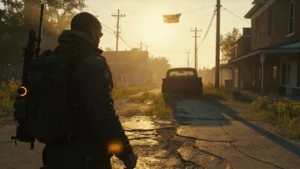
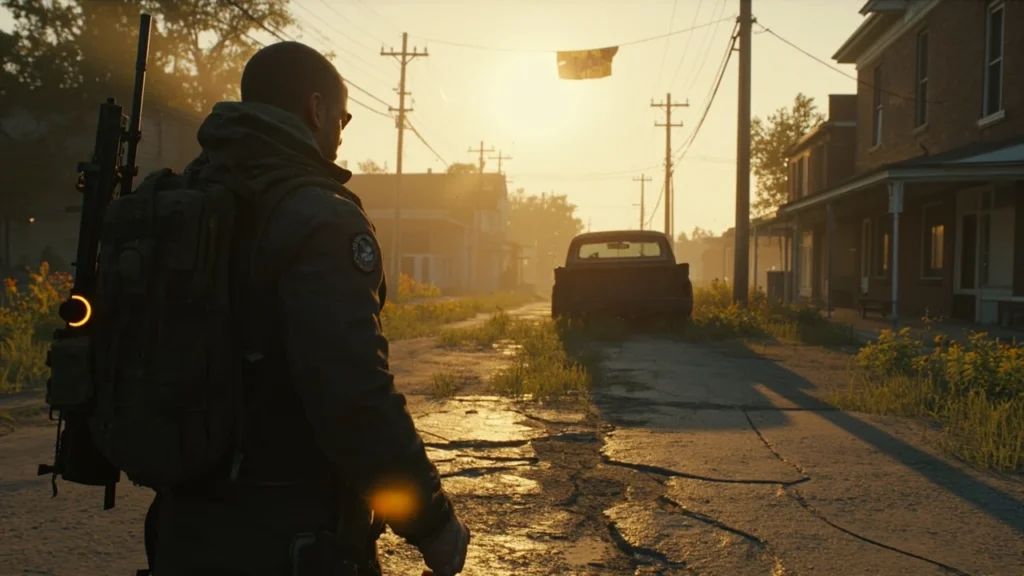
One of the clearest creative choices in The Division Heartland was the move to a rural Midwestern setting. The main Division games had used dense urban environments to support their cover-based combat and faction storytelling. A small-town and wilderness setting was a deliberate change, intended to support a different kind of tactical play. Snow, low buildings, forest lines, and long sightlines would all have replaced the alleyways and rooftops that defined the previous games.
Public materials and reporting suggested that the game would use a fictional town called Silver Creek as a hub, with surrounding wilderness and smaller outposts feeding into mission content. The design implication is significant. Urban Division combat revolves around sightlines, layered cover, and a wide variety of entry points. Rural combat tends to involve longer engagement distances, fewer hard cover options, and more emphasis on vehicles and patrol routes. AI behavior, audio design, and cinematics all have to be reconsidered for that kind of space, and that is a meaningful amount of work for a team whose previous experience was mostly urban.
| Design element | Urban Division approach | Rural Heartland approach |
|---|---|---|
| Cover density | High, layered, destructible | Lower, more spread out, often natural |
| Engagement range | Short to mid, with longer sniper duels possible | Mid to long, more open ground |
| Navigation | On foot, with rooftop traversal in some missions | More vehicle use and outdoor traversal |
| Faction presence | Rioters, cleaners, elite factions in the city | Reportedly tailored to small-town factions |
| Player fantasy | Restoring order in a collapsing capital | Operating in a quieter, more isolated frontier |
Setting is never just visual. A rural setting changes AI behavior, mission pacing, audio design, and the kind of cinematics that work. A team that had spent years designing for urban cover combat had to rethink each of those layers for a different environment, and that work would have had to be done while the rest of the game’s systems were also in motion.
Mechanics The Division Heartland was expected to ship
Because the game was cancelled before release, the mechanics list is partly reconstructed from reporting, partly from official statements, and partly from the design context of similar projects. The list below should be read as a snapshot of the public design direction, not a confirmed feature set.
- Operations as the core mode: multiplayer missions in which a small team would deploy into the map, complete objectives, and extract. This was the main hook in nearly every public description of the project.
- Crucial Point characters and factions: players were expected to choose from characters aligned with different Division factions, with each character offering a distinct role or specialty. The exact number of characters was never confirmed.
- Survival and extraction elements: the project was repeatedly compared to extraction shooters, suggesting a risk-and-reward structure where players lose progress on death. That design has implications for inventory, stash management, and match length.
- Shared world and PvPvE potential: the open question in public discussion was whether the world would include contested zones similar to a Dark Zone, or stay firmly PvE. The answer would have shaped the entire risk profile of the game.
- Cross-platform play: the game was announced for PC, consoles, and cloud, which implied a cross-play plan that would have to handle input parity, progression sync, and platform-specific certification.
What stands out about this list is how much of it depended on systems that were still being designed when the project was cancelled. Operations, faction characters, and extraction loops all had to be balanced against each other, and none of them is simple to ship on its own. Doing all three at the same time, while also moving the setting, is a heavier workload than the project’s public footprint suggested.
Production history and the path to cancellation
The Division Heartland went through a long public development cycle, and the timeline matters for any production analysis. A short history is useful here because it shows how the design shifted as the project learned more about its audience and its own technical limits.
- May 2021: Ubisoft confirms The Division Heartland as a free-to-play standalone game in development at Red Storm Entertainment, targeting PC, consoles, and cloud. Early materials suggest a 2021 to 2022 release window.
- 2022: the release window is pushed back. Public discussion begins to compare the project to extraction shooters, and developers indicate that the design has been reworked around survival and PvP elements.
- 2023: Ubisoft announces that several projects are being delayed or restructured. The Division Heartland remains in development but the release timeline continues to slip, and little new gameplay is shown.
- May 2024: as part of a broader portfolio review, Ubisoft confirms that The Division Heartland has been cancelled. Resources and team members are reassigned within the publisher.
Each of these stages involved a different kind of production risk. The 2021 announcement created external expectations that the team then had to meet or reset. The 2022 redesign forced a re-evaluation of art, missions, and tech. The 2023 delay reflected either unresolved design questions or a deliberate wait for a more favorable market window. The 2024 cancellation is best understood as a portfolio decision rather than a verdict on the individual game’s quality, and it is the kind of decision that large publishers make when several projects compete for the same resources.
Why The Division Heartland was hard to ship
Even without knowing the internal state of the project, several structural challenges were visible from outside. None of them on its own explains the cancellation, but together they describe the kind of risk that publishers worry about when deciding whether to keep funding a live-service project.
- Crowded genre: by 2023 the survival extraction shooter space already included several live products with established communities. Entering that space with a new IP-adjacent title required a clear hook, and The Division Heartland’s hook was still being defined publicly.
- Franchise expectations: the existing Division audience expected cover-based combat, gear sets, and a specific kind of endgame. A free-to-play extraction spinoff risked alienating that audience without gaining a new one quickly enough.
- Engine and tooling: the project was developed separately from the Snowdrop pipeline used by the main Division games, which meant new tooling, new asset workflows, and a smaller internal knowledge base to draw on for support.
- Free-to-play economics: the model demands strong onboarding, fast time-to-first-action, and a steady content cadence. Any gap in that cadence directly affects revenue, so delays in content production are more expensive than in a premium title.
These pressures are not unique to The Division Heartland. They describe a category of risk that has shaped almost every free-to-play shooter in the last decade, and they are worth examining in their own right when looking at a project that did not make it to launch. The lesson for other studios is that the structural challenges of a free-to-play extraction shooter do not get smaller when the project is attached to a known brand. If anything, the brand adds constraints.
What the cancellation tells other studios
For developers and producers outside Ubisoft, the most useful thing about The Division Heartland is not the gameplay it would have offered, but the patterns it illustrates. A few lessons are particularly clear from the public record.
First, genre blending is expensive. A team trying to combine the Division’s cover shooter feel, a survival extraction loop, and a free-to-play economy is not designing one game. It is designing three interlocking systems, each of which can be the reason a session feels good or bad. Studios that succeed at this kind of hybrid usually have a single strong design pillar to anchor the experience. The Division Heartland never publicly identified that pillar, and the project’s many public pivots suggest that the team was still searching for one when the project was wound down.
Second, free-to-play shooters live and die on their first 20 minutes. Players who do not understand what they are doing or why within a short window simply leave, and the cost of replacing them through marketing is high. This is a much harder design problem than a premium game, where players have already paid and are willing to learn. For a project that was also changing setting and core loop, the onboarding challenge was significant, and there was no public sign that it had been solved.
Third, internal competition matters. Ubisoft had several live-service projects in development at the same time as The Division Heartland, including XDefiant and ongoing support for The Division 2. When resources are limited, publishers tend to favor projects that have the clearest path to revenue and the lowest operational cost. A project whose design and audience were still being defined is at a disadvantage in that kind of portfolio review, regardless of the quality of the team or the code that had already been written.
Comparing The Division Heartland to other cancelled shooters
The Division Heartland is one of several high-profile shooter projects that did not reach release in the early 2020s. Looking at them side by side highlights the patterns that lead to cancellation, and the variety of business models that have been tried.
| Project | Publisher | Concept | Primary reported cause of cancellation |
|---|---|---|---|
| The Division Heartland | Ubisoft | Free-to-play Division spinoff with survival and extraction elements | Portfolio review and restructuring |
| Crucible | Amazon Games | Free-to-play hero shooter with PvPvE modes | Returned to closed beta and was eventually shut down |
| Concord | Sony | Premium-priced 5v5 hero shooter | Launch underperformance and rapid service termination |
| Hyenas | Creative Assembly / Sega | Multiplayer extraction shooter set in a hyper-capitalist future | Cancelled during broader corporate restructuring |
The table is not a judgment on the quality of any of these projects. It is a reminder that the shooter market in the last several years has been unforgiving, and that even well-funded projects with experienced teams have not survived the gap between announcement and launch. For a studio planning a new live-service shooter, the lesson is that the window between announcement and live operation is itself a design challenge, not just a marketing one. A project that announces early commits to a public clock that does not stop when the design changes.
Internal context from the broader Division ecosystem
For readers who already follow the franchise, it helps to keep The Division Heartland in context. The Division 2 launched in 2019 and received several years of expansions and seasons before its live support was wound down. The franchise has also appeared in mobile form through The Division Resurgence, which targets a different audience and platform with shorter sessions and a more guided progression curve. Heartland would have been the third active branch of the franchise had it shipped, alongside the main PC and console game and the mobile title.
That kind of multi-product strategy is common in large publishers, and it creates a constant tension between brand consistency and design experimentation. Heartland’s experimental design would have made it the most distinct of the three. For a player wondering where it fits, the closest mental model is not The Division 2 itself, but the extraction-shooter adjacent experiences that the genre has produced in recent years, with the Division’s faction and gear vocabulary layered on top.
For developers, the broader ecosystem also matters because of the tooling and engine questions it raises. Each Division product was built on a different technical foundation, which made shared art and engineering more difficult than it would have been in a single-pipeline franchise. That fragmentation is part of the reason the broader Tom Clancy’s The Division brand has been harder to scale than the Assassin’s Creed or Far Cry brands, where the central pipeline is more unified.
How the project shaped the teams that worked on it
For developers, the most lasting impact of a cancelled project is often not the public reception but what the team learns and where the team goes next. The Division Heartland’s team was working on a free-to-play shooter with custom tooling, new setting work, and a multiplayer focus. That skill set is directly applicable to a number of other live-service projects, both inside and outside Ubisoft. Multiplayer mission design, extraction loop balancing, and free-to-play onboarding are all in demand in the current job market.
Studios that have shipped cancelled projects before often retain several advantages afterward: a more realistic sense of scope, a clearer view of onboarding design, and a deeper understanding of free-to-play economics. A team that has gone through a structured cancellation is also usually better at documenting its work, which helps future projects avoid the same dead ends. The Division Heartland’s codebase may or may not survive in another form, but the design knowledge of the people who built it usually does.
For Ubisoft specifically, the lessons from The Division Heartland appear to have fed into later decisions about which projects to greenlight, how to staff free-to-play teams, and how aggressively to scale back when a project is no longer hitting its targets. Whether those lessons were applied well is a question for future releases, but the lessons themselves are visible in the public record.
Why The Division Heartland still matters to follow
Even though the game was never released, The Division Heartland still matters for anyone who studies the shooter genre. It sits at the intersection of three trends that have shaped the last decade of AAA development: the move toward free-to-play business models, the rise of extraction-style multiplayer loops, and the ongoing search for ways to extend established franchises without diluting them. Each of those trends is visible in the project’s short history, and each of them is still playing out in active releases today.
For players, the project’s cancellation is also a useful reminder that not every announced game ships, and that a long stretch of marketing does not guarantee a launch. For industry analysts, it is one more data point in the argument that AAA free-to-play shooters have a much higher failure rate than their AAA premium counterparts. For developers, it is a concrete example of how a design can shift several times in public without ever finding a stable shape, and how that instability can end a project even when the underlying technology is sound.
Frequently asked questions
What was The Division Heartland?
The Division Heartland was a free-to-play multiplayer spinoff set in the Tom Clancy’s The Division universe, developed by Red Storm Entertainment and published by Ubisoft. It was set in a rural Midwestern location and was designed around multiplayer operations with elements drawn from survival and extraction games.
Why was The Division Heartland cancelled?
Ubisoft confirmed the cancellation in May 2024 as part of a broader portfolio review during a wider company restructuring. The publisher framed the decision as a resource allocation choice rather than a quality judgment on the project itself.
Did The Division Heartland have a release date?
No. The project was delayed several times and was cancelled before a final release date was confirmed. The public version of the game never went into open beta, and only limited pre-alpha testing was reported.
Was The Division Heartland connected to The Division 2?
It shared the franchise’s lore, factions, and visual identity, but it was a separate product with its own design. It was not built on the same engine pipeline as The Division 2 and was not a continuation of that game’s story.
What kind of game was The Division Heartland supposed to be?
Public materials described a free-to-play multiplayer experience focused on team-based operations, with survival and extraction mechanics. The exact mix of PvE and PvP was still being discussed publicly when the project was cancelled.
Who developed The Division Heartland?
Red Storm Entertainment, a Ubisoft studio known for tactical shooters and long-running collaborations with the Tom Clancy brand, was the lead developer. The project was published by Ubisoft.
Is there any way to play The Division Heartland now?
No. Because the project was cancelled before release, no public build was made available and no playable version was preserved for general release. Information about the game is limited to official statements, press coverage, and a small number of industry reports.
Why was The Division Heartland free-to-play?
Ubisoft positioned the project as a way to expand the franchise’s audience without requiring an upfront purchase. Free-to-play also allowed the publisher to target platforms such as cloud streaming services and to test a different revenue model than the main series used.
How is The Division Heartland different from a Division mobile game?
The mobile Division titles are designed around touch controls, shorter sessions, and a different progression model. The Division Heartland was designed for PC and console, with longer sessions and a multiplayer focus.
What can developers learn from The Division Heartland?
The project illustrates the cost of blending several risky systems at once, the difficulty of designing onboarding for a free-to-play shooter, and the importance of a clear design pillar early in production. It is a useful case study for studios considering a similar pivot.