3D character modeling services for games: how to brief and evaluate them
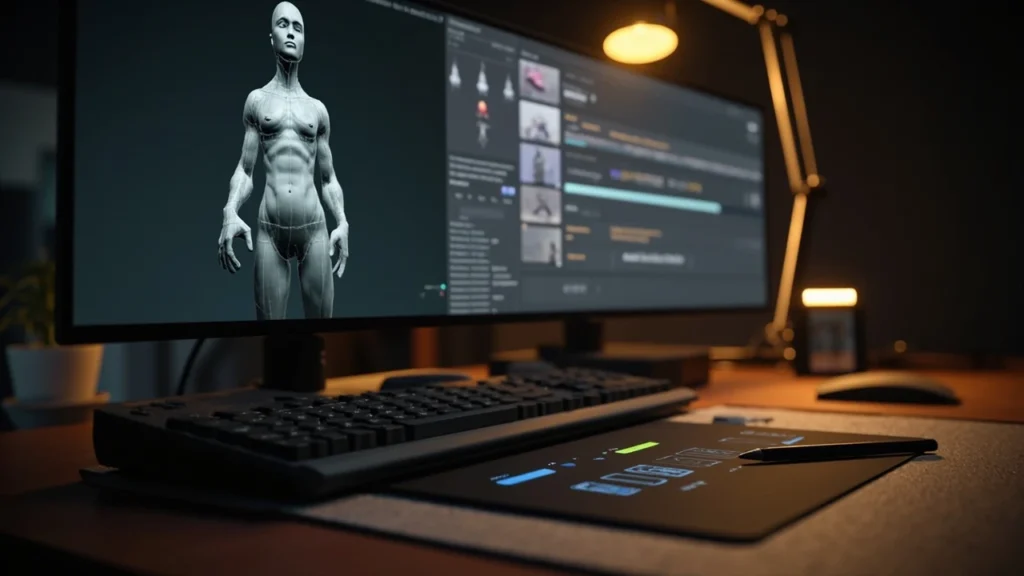
3D character modeling services in a game production pipeline
A 3D character model is the part of a game that players look at longest, photograph for social posts, and judge a studio by. Getting it right is rarely about one talented artist with a sculpting tablet. The visible mesh is the smallest part of a real delivery. The package that reaches a technical artist, an animator, or a gameplay engineer also includes proportions, silhouette, topology, UV layout, texture sets, material definitions, naming, scale, and a documented handoff that matches the engine’s expectations.
Studios and brand teams that buy 3D character modeling services usually want a partner who understands all of those layers, not just someone who can produce a beautiful sculpt. The decision becomes especially visible when the asset moves from a still beauty render into a deformable rig, an animation pass, or a real-time scene. A character that looks correct in a turntable can collapse at the shoulder, break lip sync, or tank the frame rate once it reaches the engine, and the cause almost always traces back to decisions made before retopology even started.
This article walks through how professional 3D character modeling services fit into a game production pipeline, what belongs in a useful brief, which technical artifacts to ask for during review, and where the boundary usually lies between modeling, rigging, and animation. The goal is to help a producer, technical artist, or studio lead run an evaluation that survives contact with a real schedule and a real engine.
What a character modeling engagement actually delivers
A modeling engagement is usually a chain of decisions, not a single artifact. The first decision is whether the team is buying a sculpt, a production-ready mesh, or a full character package that also covers texturing and engine export. The scope has to be written down, because the words “3D model” and “3D character” are used in many different ways across studios and marketplaces.
A typical delivery, when the brief is written carefully, can be broken into the layers shown in the table below.
| Layer | What it includes | Why it matters for a game |
|---|---|---|
| Concept and silhouette | Proportion studies, style frames, expression sketches, cost and color direction | Defines how the character reads at gameplay distance and in marketing stills |
| High-resolution sculpt | Anatomy, costume folds, facial planes, surface detail, accessories | Captures personality and visual quality before optimization |
| Retopology | Production mesh with clean edge flow, sensible polycount, supporting loops around joints and the mouth | Determines whether the model deforms cleanly and animates without artifacts |
| UVs and texture sets | Unwrapped surface, packed UDIMs or texture sheets, color, normal, roughness, metallic, and masks as required | Controls how the engine shades the character and how memory is spent on textures |
| Materials and hair | Skin, eyes, clothing, hair cards or groom, accessories, props | Defines the final look under the project’s lighting and render path |
| Handoff package | Source files, engine-ready exports, naming convention, scale, axis, documentation | Lets the receiving team plug the asset directly into the engine without re-cleaning |
Rigging, blend shapes, and animation are usually separate deliverables. A modeling studio that owns the full pipeline may also rig the character, but the brief should say so explicitly. Treating “a 3D model” as a single universal product is one of the most common sources of late-stage rework, and it shows up in nearly every postmortem that mentions a problematic character.
Where modeling sits between design, rigging, and animation
Character modeling is a handoff-heavy discipline. Each downstream stage exposes problems the previous stage could have prevented. The simplest way to keep the pipeline stable is to draw a clear boundary for what modeling owns and what it does not.
Modeling usually owns:
- Concept alignment and proportion decisions up to the approved block.
- The high-resolution sculpt and the production retopology.
- UV layout, texture painting, and the material definitions that ship with the asset.
- Scale, axis, naming, and the file structure that the rig and engine will read.
Modeling usually does not own:
- The skeleton, control rig, and skin weights, unless the contract explicitly includes rigging.
- Blend shapes for facial performance, although the mesh topology must support them.
- Animation, cinematics, or motion capture cleanup.
- Engine integration beyond an agreed export profile, unless engine integration is a named deliverable.
The boundary becomes important in two situations. The first is when a studio says it can deliver “a fully rigged and animated character at a low price.” The second is when an internal team is split between a modeling vendor and an in-house rigger. In both cases, a one-page responsibility matrix attached to the brief prevents the same asset from being optimized for one consumer and broken for another.
How a modeling brief becomes a useful decision document
A weak brief says “we need a hero character, stylized, similar to game X, around 30k polys, rigged and animated.” A useful brief walks the studio through the same set of decisions a senior producer would make internally, and ends with a short list of acceptance criteria the team can use during review.
A practical brief for 3D character modeling services usually contains the following sections.
- Role and context: who the character is, where they appear in the game, and what the player should feel when they see them.
- Audience and references: target players, brand or art direction references, comparable characters from shipped games, and any visual elements that must or must not appear.
- Technical environment: target engine and version, target platforms, expected camera distances, and any known performance budgets.
- Scope: which of the layers from the table above are in scope, with rigging, animation, and engine integration called out separately.
- Handoff: required file formats, naming convention, scale and axis, texture color space, expected documentation, and source files versus game-ready exports.
- Schedule and review gates: how many rounds of concept, sculpt, and production review are included, and what the client must provide at each gate.
- Usage rights: where the asset can appear after delivery, including marketing, sequels, and updates, and any exclusivity the studio expects.
The last item is often the most expensive to leave vague. A character that is meant to live across a campaign, a mobile port, and a sequel needs a broader license than an NPC that appears once in a single level. Producers who fix this before signing a contract usually avoid a renegotiation six months later.
Concept alignment before a single polygon is created
The cheapest stage of a character project is the one that prevents redesigns. Concept alignment is where the team agrees on proportion, silhouette, cost, color, and the expressions the face must support. A friendly educational guide needs different proportions and a different expression set from a premium brand ambassador or a horror creature, and the modeling team needs to know which one they are building before they block the first form.
Concept work usually produces a small package:
- Two or three proportion passes with clear notes on what each communicates.
- Silhouette studies from front, three-quarter, and profile angles, with weapons or accessories included.
- Color and material direction, including how the character should read against the typical lighting of the target scene.
- A short list of required expressions, with reference images for the emotions the face must reach.
This package is small relative to the rest of the project, but it is where most of the risk lives. A character that passes concept usually passes the rest of the pipeline with predictable effort. A character that fails concept tends to trigger expensive rework at the sculpt, retopology, and texture stages, because every later decision inherits the same early mistake.
From sculpt to production mesh
The sculpt is where the character gains personality. The retopology is where it gains a future. A high-resolution sculpt carries the visual detail, the facial planes, and the costume behavior that a beauty render will show. The production mesh discards most of that detail and keeps only the geometry that deforms, shades, and exports cleanly. Every supporting loop around shoulders, elbows, knees, eyes, and the mouth is a deliberate decision about how the character will move and react.
The retopology pass usually follows a small set of rules that any experienced technical artist can recognize in review.
| Area of the mesh | What clean topology looks like | What a reviewer should look for |
|---|---|---|
| Shoulders and upper arms | Edge loops that radiate from the joint and follow muscle direction | No pinching when the arm lifts, no flat shading on the deltoid |
| Elbows and knees | Loops that wrap the joint with enough geometry to bend | Smooth bend without collapsing into a hard edge |
| Wrists and ankles | Concentrated loops where the joint will rotate | Gloves and boots deform naturally, no visible creasing |
| Eyes and mouth | Loops that follow the eyelids and lip line, enough geometry for blinks and phonemes | Expressions read clearly, the mouth can hold speech shapes |
| Costume seams | Edge flow that respects cloth direction and seam placement | Texture seams hide along natural costume lines |
Topology that ignores these patterns is one of the strongest signals that the modeling team has not yet built characters for animation. The asset can still be beautiful in a turntable, but it will fight the rigger and the animator for the rest of the project. Catching this in the production review, before texturing starts, is much cheaper than catching it after the textures are painted and the rig is already weighting the mesh.
UVs, textures, and material scope
UV layout is one of the quietest sources of late-stage waste. A good layout respects the character, not just the atlas. Seams sit along costume edges, hair parts, or hidden surfaces. UDIM tiles or texture sheets are organized so that materials can be updated without re-baking the whole character. Texel density is balanced between the face, the body, and any accessories that share a material, which keeps the character from looking like two characters that happen to be standing next to each other.
The texture brief usually has to answer a few specific questions before work begins.
- Which maps are required: base color, normal, roughness, metallic, opacity, and any masks for variation or wear.
- What resolution the textures should reach, with separate targets for hero, mid, and background characters.
- What color space the project uses, since a sRGB base color paired with a linear normal map is a common source of subtle shading bugs.
- How hair is handled, since hair cards, hair grooms, and scalp meshes all change the topology and texture budget.
- How the character is meant to age, whether wear and tear are part of the brief, and whether a separate dirty variant is required.
These answers are usually specific enough that the production team can write them into the brief and the modeling team can deliver against them without further negotiation. Vague wording here is what produces a character that is technically complete but visually inconsistent with the rest of the project.
Platform and engine expectations
The same character can pass review for a cinematic trailer and still fail to load on a mid-range mobile device. The platform list is therefore part of the modeling decision, not a separate step that happens later. A modeling team that knows the target engine can design the topology, the texture budget, and the material set to fit it. A team that receives a generic high-resolution sculpt and is told to “make it work in our engine” is being asked to solve a problem that should have been prevented upstream.
The most common platform and engine expectations look like this.
| Target | Typical poly budget | Typical texture set | Other expectations |
|---|---|---|---|
| PC or console hero | From 30k to 80k triangles, depending on the project’s art direction | 4K sets with full PBR maps and supporting masks | Clean LOD chain, optional hair groom, full blend shape support |
| Mid-range mobile | From 8k to 20k triangles for a hero, lower for background characters | 1K to 2K sets, often packed, with a careful roughness and metallic budget | Aggressive LOD, optional atlas sharing, no heavy hair grooms |
| Real-time avatar or web | From 5k to 15k triangles, depending on platform and target frame rate | Compact sets, with compression-friendly maps and minimal transparency | |
| Cinematic or pre-rendered cutscene | Often higher than the gameplay mesh, with separate high-resolution sculpts | Large texture sets, subsurface scattering, complex materials | Beauty passes and lighting handled by a separate cinematic team |
Real-time avatars and web-based characters sit in a different category from cinematic ones. A brand ambassador that appears inside a conversational experience has to look consistent from uncontrolled camera angles, respond quickly, and support repeatable gestures without breaking performance. Studios that understand the difference between an interactive character and a pre-rendered one tend to scope the modeling pass very differently.
Evaluating a 3D character modeling studio before signing
Most evaluations collapse into a few practical checks. A team that has built characters for games before will have answers ready for each of these, and a team that has not will often describe the work in language that does not survive contact with a real engine.
- Ask for a production-ready sample, not a beauty render. A turntable on a T-pose reveals very little about how the character will deform or shade.
- Ask to see the production mesh, the UV layout, and a textured character in the target engine. The combination is the closest thing to a real test.
- Ask how the studio handles topology, retopology, and supporting loops. A confident answer mentions edge flow around joints and the mouth without prompting.
- Ask for an example of a previous handoff package. The structure of the file delivery tells you how the team thinks about downstream consumers.
- Ask how the studio handles revisions and what happens when an animation pass exposes a topology problem. The answer is usually a good predictor of the working relationship.
Producers who have run this kind of evaluation often say that the most useful evidence is not the studio’s portfolio but the studio’s response to a small paid test. A short, well-defined character task that ends with a production mesh, a UV layout, and a documented handoff is more informative than any number of showcase renders.
Common failure modes and how to prevent them
Most failed 3D character modeling engagements fall into a small number of recurring patterns. The patterns are worth naming, because each one has a relatively cheap prevention.
- Beautiful sculpt, broken retopology. The character looks correct in a turntable but pinches or collapses in animation. Prevention: review the production mesh before texturing starts, with a simple bend test for the arms and knees.
- Texture set that does not match the engine. The maps arrive in the wrong color space, with missing roughness or metallic channels. Prevention: write the texture format, color space, and channel list into the brief and into the handoff document.
- Hair that fights the platform. Heavy hair grooms or high-poly hair cards that look right in a beauty render but tank performance on the target device. Prevention: name the platform in the brief and ask for a hair plan before the sculpt is approved.
- Scope creep after the sculpt is approved. A new costume, weapon, or facial expression is added without adjusting the schedule. Prevention: write the change-control path into the contract, including the cost of late additions.
- Asset that cannot be updated. A character built from a single monolithic texture set with no UDIMs or masks is expensive to refresh when the game changes. Prevention: ask for modular texture sets and named materials even on small characters.
None of these failure modes is a mystery. They are listed in postmortems across the industry, and they are the reason that 3D character modeling services are usually evaluated on the production package, not on the still image.
Production guidance for teams buying external modeling
Studios that buy 3D character modeling services regularly tend to standardize a few things. The goal is to make the briefing and the review process predictable enough that the production team can focus on the part of the work that actually requires creative judgment.
A practical checklist usually includes the following items.
- A one-page responsibility matrix that names what the modeling studio owns and what stays in-house.
- A standard review package that includes a turntable, a neutral pose, a bend test, and a short engine test scene.
- A handoff template that lists required file formats, naming conventions, scale, axis, texture color space, and documentation.
- A change-control note that explains how new requirements are added and how the schedule is updated.
- A usage-rights clause that covers marketing, sequels, ports, and any licensed platforms the asset will appear on.
Teams that adopt this kind of template usually find that their modeling vendors respond more accurately, because the brief removes the ambiguity that drives most rework. The template also makes it easier to compare vendors during a bidding process, because the answers can be compared against the same set of expectations.
How to read a modeler’s portfolio without being misled
Portfolios are useful, but they reward skills that are easy to film. A reel full of beauty renders, dramatic lighting, and cinematic camera moves tells the viewer almost nothing about how the characters would behave in a real engine. Producers who have been burned by this often look past the reel and into the structure of the assets themselves.
A few signals are usually worth tracking down.
- The presence of wireframes or topology passes in the reel, which suggests the artist understands production needs.
- Examples of the same character in different lighting conditions, which is closer to what gameplay actually requires.
- Engine screenshots or short real-time clips, even if the lighting is rough, because they show the asset under engine constraints.
- Variants and LODs, since a character that ships with a believable LOD chain was built for production rather than for the reel.
- Documentation and file structure, if the studio is willing to share a redacted example, because a clean file structure is a strong indicator of how the team thinks about handoff.
For a deeper look at how modeling connects with the rest of a 3D production pipeline, this overview of 3D character modeling services covers the same scope decisions in more detail, from concept alignment through animation handoff.
What the production handoff actually looks like
A clean handoff package is the most visible difference between a studio that has shipped characters and one that has not. The package usually contains the source files, the engine-ready exports, a short README, and a small set of test renders or scenes that prove the asset behaves as expected.
A typical handoff for a game-ready character might include the items below.
- The source scene from the modeling software, with the production mesh, the UVs, and the texture nodes intact.
- An FBX, glTF, or USD export at the target engine’s expected scale, with the skeleton if rigging is in scope.
- Texture sets in the agreed resolution, color space, and naming convention, including any masks and packed maps.
- A short README covering the unit scale, axis orientation, material naming, and the version of the software used to export.
- One or more test scenes, often a neutral T-pose and a simple bend or expression test, that the receiving team can use to validate the import.
Teams that consistently deliver this kind of package usually charge more than teams that send a single mesh and a folder of textures, and the difference is almost always worth the additional cost once the asset starts moving through the rest of the pipeline.
Decision points that a milestone review should answer
Each review gate in a character project should answer a small set of focused questions. Reviewers who try to evaluate the whole character at once usually end up approving a problem that resurfaces in animation, and teams that split the review into named milestones tend to catch the same problem much earlier.
A common gate structure looks like this.
- Concept gate: does the character read correctly at gameplay distance, and does the silhouette tell the player what the character does?
- Block gate: do the proportions, the costume, and the basic expressions work in 3D, and is the direction ready for high-resolution work?
- Production mesh gate: does the retopology support the planned animation, and is the texture budget realistic for the target platform?
- Texture and material gate: do the materials behave correctly under the project’s lighting, and is the character consistent with the rest of the cast?
- Handoff gate: does the package match the brief, and can the receiving team import the asset without manual cleanup?
A clear answer at each gate is what turns a modeling engagement from a creative gamble into a production process. The team that buys the work benefits from clearer feedback, and the studio that delivers it benefits from fewer late-stage surprises.
Where to draw the line with in-house production
Many studios can justify a small in-house character team for the recurring cast, and an external partner for one-off NPCs, creatures, or marketing characters. The decision usually comes down to three questions.
- How many characters does the project need, and how often do they need to be updated?
- How specialized is the art direction, and how much of the work is reusable across characters?
- How predictable is the schedule, and how sensitive is the project to late changes?
Projects with a large recurring cast usually benefit from a small core team that owns the style and the pipeline, with external studios used to absorb the bulk of the workload. Projects with a small, deeply specialized cast often keep the entire character work in-house to protect the visual identity. Either approach is defensible, as long as the decision is made before the schedule is set, and the boundaries between in-house and external work are written down.
Frequently asked questions
What should a 3D character modeling service include for a game?
A game-focused modeling service usually includes concept alignment, a high-resolution sculpt, a production mesh with clean topology, UV layout, texture painting, materials, and an engine-ready export. Rigging, blend shapes, and animation are normally separate deliverables unless the contract names them as in scope. The handoff package should also include a short README covering scale, axis, naming, and the version of the software used for the export.
How is a game character model different from a film or advertising model?
Game characters are built for real-time rendering and for deformation. Topology has to support the planned poses, the texture budget has to fit the target platform, and the material set has to work under the engine’s lighting. Film and advertising models are usually optimized for beauty renders, with higher polycounts, larger textures, and no need to deform under a rig.
How do I check topology before approving a character model?
Ask the modeling team for a production mesh, not a sculpt, and run a simple bend test on the arms, knees, and torso. Look for edge flow that radiates from each joint, supporting loops around the eyes and mouth, and seams that follow natural costume lines. A model that passes these tests will usually behave well under a rig and under animation.
What polycount should I target for a game character?
Polycount is project-specific, but a common starting range is 30k to 80k triangles for a PC or console hero, 8k to 20k for a mid-range mobile hero, and lower for background characters. The right number depends on the art direction, the camera distance, and the rest of the scene. A character that is seen in cinematic close-ups needs more geometry than a character that only appears at gameplay distance.
Should the modeling studio also rig the character?
Only if the contract says so. Modeling and rigging are different disciplines, and a studio that excels at one does not automatically excel at the other. The cleanest approach is to keep the scopes separate, write a clear responsibility matrix, and let the rigging team be a separate reviewer of the production mesh before texturing begins.
What should the handoff package contain?
At minimum, the source scene, an engine-ready export at the correct scale, the texture sets in the agreed format and color space, and a short README. A simple test scene with a neutral T-pose and a basic bend or expression test makes the import much easier to validate on the receiving side.
How long does a character modeling project usually take?
Timelines depend on the scope, the revision count, and the platform. A single stylized character with concept, sculpt, retopology, textures, and a documented handoff usually takes several weeks of focused work for a small team. A realistic hero character with multiple expressions, hair, and costume variants can take several months. The schedule should be written into the brief, with named review gates and a clear change-control path.
What is the difference between a sculpt and a production mesh?
The sculpt is the high-resolution model that carries the visual detail. The production mesh is the optimized version that actually ships, with cleaner topology, a sensible polycount, and supporting loops around the joints. A character usually passes from sculpt to production mesh through a retopology pass, and the production mesh is what the rigger, the animator, and the engine will use.
How do I avoid late-stage rework on a character?
The most reliable prevention is a well-written brief, a clear scope, and named review gates. Concept alignment, the production mesh, and the texture set are the three stages where most rework starts. Catching problems at those three stages, before the next stage begins, is much cheaper than catching them after the rig is already weighting the mesh.
What is the difference between modeling for a hero and modeling for an NPC?
A hero character usually needs more polygons, more textures, more expressions, and a longer production schedule. An NPC or background character is usually built to a lower budget, with simpler expressions, fewer texture sets, and a more aggressive LOD chain. The two roles are designed for different camera distances and different levels of player attention, and the brief should reflect that difference rather than treating every character as a hero.