Virtual game development company: how remote studios actually work
Virtual game development company: what the term actually covers
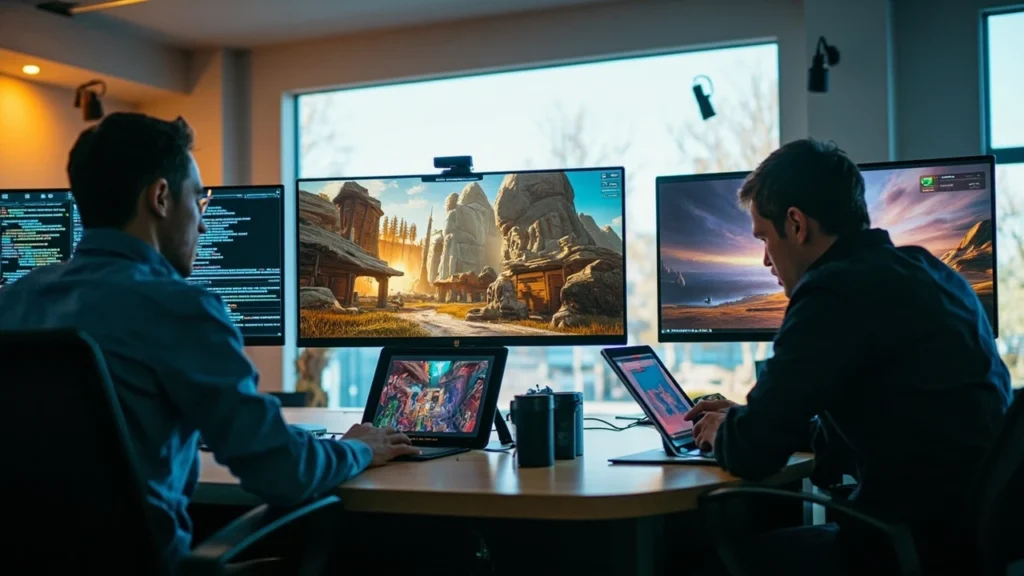
A virtual game development company is a studio whose core team works from distributed locations rather than a single shared office. Code, art, audio, design, production, and QA all happen across home offices, coworking spaces, and small regional hubs, and the team’s identity is bound to its products, tools, and processes instead of an address. For independent and mid-sized studios this is now the default operating model, and even large publishers increasingly run virtual or hybrid groups for live operations, porting, and content updates.
People searching for the phrase are usually trying to answer one of three questions. Some want to understand what a virtual studio is and how it differs from a traditional in-house one. Others want to know what working inside a remote game team looks like, including roles, hours, and management. A third group is evaluating whether to hire or partner with a remote studio and needs to understand the practical limits, risks, and review points. This article keeps all three intents in view, but its spine is the production reality: how a virtual game development company is structured, how it ships work, and where the model breaks down.
How a virtual studio differs from a traditional one
A traditional studio concentrates people, hardware, and decisions in one building. Motion capture, sound stages, color-graded review rooms, whiteboards, and a single secure network all sit within walking distance. A virtual studio spreads the same functions across locations and substitutes tools, process, and trust for proximity. The differences show up in five recurring areas: collaboration, communication, accountability, infrastructure, and culture.
| Dimension | Traditional in-house studio | Virtual game development company |
|---|---|---|
| Primary collaboration space | Shared office, meeting rooms, whiteboards | Cloud workspaces, source control, chat, video calls |
| Communication cadence | Drop-in conversations, frequent in-person reviews | Scheduled calls, written updates, recorded reviews |
| Decision authority | Often settled face to face in the room | Documented in tickets, chat threads, written design docs |
| Infrastructure ownership | On-site servers, secure LAN, licensed seats | Cloud builds, SSO, license servers, VPN or zero-trust |
| Culture signals | Physical rituals, shared space, visible hierarchy | Written norms, rituals online, transparent artifacts |
Each row carries a trade-off. A virtual studio pays for distributed infrastructure and extra process, but it gains access to talent that is not willing to relocate, and it can ramp teams up or down without signing a long lease. A traditional studio pays rent and limits its hiring pool, but it shortens the feedback loop for reviews, hardware-heavy content, and fast design pivots. Most working teams end up as a hybrid, with a small physical hub for motion capture, hardware testing, or onboarding, and a wider remote perimeter for everything else.
The three models a virtual studio usually fits into
The 1990s taxonomy of telecommuting, temporary alliance, and email corporation still maps onto most studios you will meet today. Understanding which model a team uses helps you predict how decisions are made, who owns what, and where the company is legally exposed.
- Telecommuting studios are usually subsidiaries or satellite arms of a larger publisher. The parent company owns the brand, the IP, and the bank account; the virtual group contributes art, engineering, or QA from home. The remote team is a delivery unit, not a free-standing company.
- Email or fully virtual studios are independent companies whose president, engineering team, and operations all sit in different places. They run on chat, source control, and shared documentation. Most independent and many mid-sized studios that ship their own IP fall into this category, and the legal and tax implications are the most complex of the three.
- Temporary alliances are short-lived partnerships in which several studios co-produce a single title or live service. Each partner keeps its own identity, IP, and accounting, and a thin coordinating layer manages scope, handoffs, and shared revenue. Co-development deals, porting partnerships, and live-ops support contracts tend to look like this even when the paperwork is more elaborate than the 1990s version.
These categories are not exclusive. A single virtual game development company can run a permanent email-style team and also enter an alliance with another studio for a port, while receiving a publisher’s funding that effectively makes it a long-term telecommuting partner. Knowing which layer a contract sits in clarifies who has authority over hiring, who signs off on milestones, and who carries the legal exposure when something goes wrong.
Roles inside a virtual game development company
A remote team needs the same disciplines as an in-house one, but several roles either grow in scope or split into new sub-roles that barely exist on site. The list below is not a job board; it describes the work that has to be done somewhere, regardless of who holds the title.
- Producer or program manager. Owns the schedule, the dependency map, and the cross-discipline review cadence. In a virtual studio, the producer also acts as a stand-in for the informal coordination that an in-office team gets from overheard conversations.
- Technical director or lead. Sets the source control policy, the build pipeline, the engine branch strategy, and the on-call rotation. Because every engineer sits in a different network, infrastructure decisions belong to this role from day one.
- Remote-first IT or DevOps. Manages identity, single sign-on, license servers, and asset delivery. In a virtual studio, IT is not a help desk; it is a core development dependency.
- Discipline leads for design, engineering, art, animation, audio, and QA. Each lead sets the review artifacts their discipline uses, such as design docs, playtest reports, dailies, and bug triage, and is responsible for capturing decisions in writing.
- People operations or community manager. Owns onboarding documentation, written culture norms, and the asynchronous social rituals that replace a shared break room. Many virtual studios underinvest here and pay for it later in turnover.
- Security and compliance lead. Handles data classification, NDA tracking, audit trails, and platform-holder security questionnaires. The role is often part-time at small studios and a full position at medium ones.
Roles can be shared early in a project, but as the team crosses roughly twelve to fifteen people, the producer, the technical lead, and the IT owner almost always need to become full-time. Splitting one of those across two people who each have their own discipline usually produces a bottleneck that costs more than the saved salary.
Core workflows that have to be redesigned for remote work
Plenty of workflows in a game studio are already written down. Source control, ticketing, and art reviews leave a paper trail by design. Others depend on physical presence: motion capture sessions, hardware bring-up, lighting reviews on calibrated monitors, voice recording, and in-room playtesting. A virtual game development company has to either move those workflows online, replace them with surrogates, or build a small physical hub that hosts them. The mapping below shows the typical choices.
| Workflow | In-office default | Virtual studio substitute |
|---|---|---|
| Code review | Pairing at a desk, screen share in a meeting room | Pull request reviews, automated CI, recorded walkthroughs |
| Art review | Color-graded monitor in a review room | Calibrated remote monitors, web-based review tools, recorded video passes |
| Design review | Whiteboard session with the team in the room | Shared digital whiteboards, pre-read docs, structured playtest reports |
| Animation and mocap | On-site stage with director and performer | Remote capture with a small crew, on-site stage booked per session |
| Voice recording | In-studio booth with director on the other side of the glass | Remote directed sessions, ISDN or modern IP alternatives, or hub-based booking |
| Hardware QA | Lab with racks of consoles and devices | Shipped dev kits, a small physical lab, contracted test partners |
| Build verification | Manual smoke tests after each build | Automated smoke tests in CI, scheduled nightly verification builds |
Each substitution has a real cost. Remote mocap introduces latency that affects how a director can coach a performer. Remote color review risks drift when monitors are not calibrated to a known standard. Remote hardware QA turns a quick rack swap into a shipping cycle. The right answer is rarely “all remote” or “all in-office”; it is a deliberate split between workflows that scale virtually and ones that still benefit from a physical location.
Communication, documentation, and the daily rhythm
Communication is the single largest variable in a virtual game development company. The team that documents its decisions, ships written updates, and runs predictable meetings outperforms the team that relies on spontaneous chat. The first habit to build is a clear answer to three questions for every recurring conversation: who needs to be in the room, what artifact comes out of it, and where that artifact lives afterwards. Without that answer, meetings multiply and the chat tool becomes a graveyard of unresolved threads.
Most virtual studios converge on a similar daily rhythm, even when the tools differ. A short daily standup, run by text in a single thread rather than by video, keeps the floor noise low. A longer cross-discipline review once or twice a week uses video because facial cues still matter for creative disagreements. A weekly written update from each lead replaces the hallway summary that an in-office producer would absorb passively. The point is not to copy a specific ritual but to make sure every decision that affects more than one person ends up somewhere durable.
Time zones also shape the rhythm. A team spread across three or more time zones usually cannot run a real synchronous standup, so it shifts to a written log and reserves synchronous time for high-bandwidth events like playtest reviews or design pivots. Teams spread across one or two time zones can still run live standups, which preserve the social glue that a fully asynchronous team must replace with other rituals. Neither model is inherently better; the right choice depends on the project’s decision density and the team’s appetite for written communication.
Tools that hold a virtual studio together
Tools do not create a virtual game development company, but the wrong toolset will quietly sink one. The list below is a pragmatic minimum for a studio that has moved past the prototype stage and is shipping or maintaining a real product.
- Source control with a real branching model. Perforce is still common in larger studios, Git with a trunk-based or short-lived branch model is common in smaller ones. Either works, but the studio needs a written policy for branches, reviews, and merges.
- A single ticketing and project tracker. Whatever the engine, every discipline should be tracking work in the same tool. Splitting bugs, features, and tasks across separate systems reliably creates the same blind spots that an office would have caught in passing.
- Cloud build and test infrastructure. Without it, every engineer waits for someone else’s machine. The infrastructure should be able to spin up a clean build, run smoke tests, and produce a shareable artifact on demand.
- A digital review tool for art and design. Web-based review tools, recorded video passes, and frame-accurate comments matter more than the specific vendor. The point is to replace the in-room color review with a documented one.
- Identity, SSO, and a license server. A virtual studio that has not solved single sign-on, hardware key management, and license distribution will spend a measurable share of every week on access issues.
- A shared, versioned design bible. Mechanics, level design notes, narrative outlines, and tech design documents all live in a single searchable place, not in personal drives or chat threads.
The phrase itself has a long history in business writing. In the 1990s, when email and dial-up were the main coordination tools, an early industry analysis already grouped remote game companies into three families: telecommuting corporations that simply sent staff home, temporary alliances that pooled different companies for a single product, and email corporations that ran the whole business from inboxes and modems. That framing still reads accurately today, only with chat apps, cloud workspaces, and engine-specific collaboration tools standing in for the dial-up era. A useful overview of those original categories and the legal questions they raise is preserved in Game Developer’s piece on structuring options for a game studio, which remains a clear reference for how a distributed game company has always been understood.
Tooling choices should be reviewed at least once a year. The temptation to consolidate everything into one platform is real, but a monolithic suite that does every job poorly is usually worse than a small set of best-of-breed tools with a clear integration plan.
Production planning for a distributed team
Scheduling in a virtual studio is harder than in an in-office one because every handoff between disciplines has a real communication cost. A producer who plans as if a build can be passed from engineering to QA within the hour will be wrong by an order of magnitude. A more honest plan assumes a half-day to a full day of latency per handoff and reserves synchronous time for the moments when the latency becomes the bottleneck.
Milestones in a remote studio also need more defined acceptance criteria. An in-office team can absorb ambiguity because a producer can walk over to a lead and ask what “feature complete” means. A virtual team needs that conversation captured in writing before the milestone, with concrete deliverables, owners, and review artifacts. When acceptance criteria are vague, the studio ends up in long written arguments about whether a build met the milestone, which is exactly the situation a remote-first process is supposed to avoid.
Capacity planning deserves the same care. A virtual studio that fully loads every engineer at 100 percent of their week is planning for failure, because there is no slack for the unexpected infrastructure issue, the platform-holder build break, or the bug that needs a quiet day to track down. Most sustainable remote studios target around 70 to 80 percent of nominal capacity for hands-on production work and treat the rest as overhead, learning, and recovery. The number is not a target to copy, but the principle that some capacity must be protected is universal.
Risks and failure modes specific to virtual studios
Virtual game development companies are not weaker than in-office ones by default, but they have a distinct failure profile. A studio that has not anticipated these failure modes will learn about them the hard way.
- Decision decay. Important decisions get made in chat threads and then are forgotten because nobody captured them in a design doc. The product slowly drifts, and the team cannot reconstruct why a feature looks the way it does.
- Onboarding drag. A new hire cannot absorb context by overhearing colleagues. Without a written onboarding path, the first three months of a remote hire cost far more than the equivalent period for an in-office one.
- Meeting bloat. A distributed team that is afraid of missing context schedules more meetings. The cure is written updates, recorded reviews, and a clear policy on which meetings are mandatory.
- Time-zone debt. The team gradually shifts its meetings to a window that favors one region, and contributors in other regions quietly become second-class. This is a cultural failure as much as a scheduling one.
- Build and infrastructure rot. With nobody walking past the build server, nobody notices that smoke tests have been red for two weeks. A virtual studio has to invest in dashboarding and on-call discipline to avoid this.
- Security gaps. Working from home networks, on personal devices, with shared family computers, opens paths that an office network would not. The studio has to enforce device management, MFA, and data classification deliberately.
Each item has a known mitigation. Decision decay is solved with a written log and a habit of linking tickets to design docs. Onboarding drag is solved with a structured first-month plan. Meeting bloat is solved with written updates and recorded reviews. The pattern is the same in every case: write it down, make it visible, and assign an owner.
Working inside a virtual game development company
For developers, designers, artists, and other contributors, a remote game studio rewards a particular kind of discipline. Self-direction matters more than in an office, because nobody is going to tap you on the shoulder and ask why a task is still open. Written communication matters more, because a one-line chat reply will not be enough to align a cross-discipline decision. The trade-off is real flexibility: a virtual studio is often the only way to ship a game while living somewhere far from a major game industry hub.
Career growth in a virtual studio also looks different. Promotions usually require a written case for impact, because the lead cannot rely on a year of casual observation. Mentorship is more structured, often scheduled, and frequently cross-discipline. People who enjoy deep work and can manage their own time tend to thrive; people who rely on the social structure of an office to plan their day often struggle. Neither profile is better, but the fit is real and worth taking seriously before joining a remote team.
Burnout is a separate concern. A virtual studio can blur the boundary between work and home in a way that an office never does. Studios that handle this well set clear on-call hours, log off chat, and protect weekends. Studios that handle it badly end up with engineers online at midnight and producers answering messages on Sunday. The model is not the cause of the burnout, but it removes the natural off-switch that a commute provides, so the studio has to install its own.
When a virtual model is the wrong choice
There are projects for which a virtual game development company is simply the wrong tool. A large-scale AAA campaign that depends on a custom engine, a deeply integrated narrative and art pipeline, and heavy on-site review often runs more cheaply and more predictably in a physical studio, at least until the project is far enough along to spin out a virtual maintenance team. A project that depends on rapid whiteboarding and frequent room-scale playtesting will also struggle to be fully virtual.
There are also phases within a project where the answer changes. Concept and preproduction work tolerates a lot of remote collaboration because the artifacts are documents, prototypes, and short video clips. Production wants more synchronous review. Live operations and content updates usually scale well as a virtual effort because the work is incremental and reviewable in isolation. Choosing the right model for each phase is often more important than choosing the model for the company as a whole.
Finally, the question of company structure matters here, not just project structure. The legal and tax complications of running a fully virtual company across multiple jurisdictions are not theoretical, and they are not solved by a chat tool. The historical analysis of email corporations still applies: a company without a clear physical nexus has to be deliberate about where it is incorporated, where it is registered to do business, and how it handles sales tax on digital goods. The production reality of a virtual studio cannot be separated from the legal reality of a virtual company.
How to evaluate a virtual studio as a client or partner
For a publisher or external partner choosing a virtual game development company, the same checklist keeps coming up across successful engagements. The list below is a starting point, not a guarantee.
- Ask for the production artifacts the team actually uses, not the marketing deck. A real team has live tickets, real branches, real build numbers, and written milestone reports.
- Check the on-call and incident response story. A virtual studio that cannot describe how a build break at 2 a.m. is detected and escalated is not yet running serious production.
- Look at the security questionnaire the studio sends back. The quality of its answers, especially around device management, data classification, and NDA tracking, is a strong signal of how the rest of its operations look.
- Visit a real review meeting. A recorded playtest review with discipline leads, a producer, and a written follow-up is more informative than any proposal.
- Ask about retention. A virtual studio with high annual turnover is paying a hidden tax on every project, and the cost usually shows up in quality, not in the invoice.
- Read the contract for scope, acceptance criteria, and IP. The legal scaffolding of a virtual engagement is the easiest place to discover mismatched expectations.
None of these steps require the studio to be physically nearby. That is the point. A virtual game development company should be evaluated on the quality of its artifacts, its people, and its decisions, all of which can be reviewed remotely. If the studio cannot show those clearly, that is itself a signal.
Frequently asked questions
What is a virtual game development company?
A virtual game development company is a studio whose core team works from distributed locations rather than a single office. Collaboration runs through cloud workspaces, source control, chat, and video calls, and the team’s identity is tied to its products and processes rather than to a physical address.
How is a virtual studio different from a regular remote team?
A regular remote team is usually a delivery unit inside a larger company. A virtual game development company is structured as a standalone business that happens to operate without a central office, which means it has to make its own decisions about legal structure, finance, security, and tooling that an in-house remote team would inherit from its parent.
Do virtual game studios actually ship commercial games?
Yes. Many independent and mid-sized studios ship commercial games entirely remotely, and publishers increasingly run virtual or hybrid teams for live operations, porting, and content updates. The remote model is no longer experimental in the game industry.
What tools does a virtual game development company need at minimum?
A virtual studio needs source control with a real branching model, a single ticketing and project tracker, cloud build infrastructure, a digital review tool for art and design, single sign-on and a license server, and a shared, versioned design bible. The specific vendors matter less than the discipline of using the same set of tools across the team.
What are the biggest risks of a virtual studio?
The most common risks are decision decay, slow onboarding, meeting bloat, time-zone debt, build and infrastructure rot, and security gaps. Each of these has a known mitigation, and most of them come down to writing things down and assigning owners.
How do virtual studios handle motion capture, voice recording, and hardware QA?
These workflows are the hardest to virtualize. Most studios either book a small physical lab for capture and recording sessions, contract with a partner studio that owns the hardware, or run a hybrid model in which a small on-site crew handles the physical work and the wider team joins remotely for direction and review.
Can a virtual game development company be just as productive as an in-office one?
Yes, when the team has invested in the right processes, tools, and writing discipline. A virtual studio that has not made those investments will be slower than an in-office one, because every handoff carries a communication cost that proximity would have absorbed. The model is not inherently faster or slower; it is a different shape of the same work.
How do virtual studios handle time zones?
Most teams adopt one of two patterns. Teams spread across one or two time zones keep live standups and reserve asynchronous time for written updates. Teams spread across three or more time zones shift to a written log and reserve synchronous time for high-bandwidth events like design reviews or playtest passes. Either pattern works when it is set deliberately.
What legal structure works for a fully virtual game studio?
The right structure depends on where the founders live, where the team is distributed, where the customers and players are, and where the studio’s servers and bank accounts sit. A virtual game development company usually incorporates in one jurisdiction and registers to do business in any other jurisdiction where it has enough activity to trigger that requirement. The right answer is jurisdiction-specific and worth taking to counsel.
Is a virtual game development company cheaper to run than a traditional studio?
It is usually cheaper on real estate, hardware, and relocation, and more expensive on tooling, security, and process overhead. Whether the net cost is lower depends on the project, the team, and how well the studio invests the savings. A virtual model that simply skips the office without investing in process usually loses the savings to inefficiency.