Rings of Power season 3: what game developers can take from its production pipeline
Rings of power season 3 and what it means for game production
A premium fantasy series is rarely built the way a game is built, yet the schedules, asset budgets, and review gates look surprisingly familiar once you step past the camera. Rings of power season 3 has been framed publicly as the conclusion of a multi-year shoot rooted in New Zealand, with the production team carrying forward the virtual volume, dialect work, and creature pipeline established in earlier seasons. For a game developer or technical artist, that framing is useful because the show sits at the intersection of film and real-time rendering: large-scale environments, persistent digital assets, and a delivery cadence that mirrors how a AAA studio plans content drops across several years.
This article is a GameDev read of the series rather than a recap. The goal is to translate the publicly reported production structure of rings of power season 3 into decisions that a developer, technical artist, or producer can compare against their own pipeline: how virtual production volumes change previsualization, how Wētā FX and Wētā FX-adjacent vendors handle huge creature and environment counts, and how a multi-season plan shapes asset reuse versus new-build budgets. If you are a player looking for plot spoilers, episode counts, or release rumors, this page is the wrong tool; if you are a developer looking for production patterns, the rest of the article walks through them in order.
Why rings of power season 3 is a relevant case study for real-time pipelines
The Amazon Studios adaptation of Tolkien’s Second Age is a useful reference point for game work because the same vendors that contribute to the show also service major game engines. Wētā Workshop contributes design and physical prop work, while Wētā FX handles high-end visual effects. Both vendors have overlapping teams with Unreal Engine, in-engine cinematics, and digital twin work for games. When a series like this commits to a long multi-season plan, the questions its producers ask about asset reuse, continuity, and review cadence map almost one-to-one onto a live-service game’s seasonal plan.
There is also a practical reason to study this show’s pipeline: it is one of the few publicly documented high-budget productions that has openly discussed virtual production volumes, on-stage LED walls, and in-camera visual effects. For a developer evaluating in-engine cinematics or virtual scouting, the rings of power season 3 workflow is a useful proxy because the engineering constraints (latency, color management, scene scale, asset versioning) are the same ones a real-time team hits in Unreal or Unity.
The rest of this page treats rings of power season 3 as a documented production, not as a content recommendation. Where the show’s decisions are described, they are tied back to engine or production concepts that a developer can act on. Where details are not publicly verifiable, the article either says so or uses the gap as an opportunity to describe how a studio would normally close it.
How a multi-season plan changes asset and scheduling decisions
A multi-season plan is the single biggest factor shaping how a show like rings of power season 3 budgets its work. The producers know roughly which characters survive, which locations return, and which set pieces are escalated. That lets the team amortize expensive assets over multiple seasons rather than writing them off after one episode. For a game, the equivalent is a content roadmap where a hero character, a major biome, or a signature mechanic has to keep paying back across several patches or expansions.
Asset reuse as a first-class production goal
On a long-running show, asset reuse is planned, not accidental. A creature built in season 1 needs to remain animatable, re-rigged, and re-skinned in season 3, often by a different vendor than the one that built the original. The same problem exists in a live-service game: a weapon or character from launch has to be compatible with a new shader pipeline, a new physics system, or a new animation retargeting scheme three years later. The interesting question is not whether to reuse, but how aggressively to standardize the asset formats so that reuse is cheap rather than painful.
Studios that handle this well tend to converge on a small set of authoritative formats: a single naming convention, a single set of LOD rules, and a single retargeting skeleton. Rings of power season 3 inherits the creature and environment library from earlier seasons, which is the production equivalent of a game team keeping a stable master skeleton and a stable material function library across years of content.
Scheduling pressure and the cost of late changes
Long plans create a paradox: more time to think, but a higher cost when a decision changes late. By the time rings of power season 3 is in post, locked designs from earlier seasons constrain the team in ways that a single-season show never has to accept. A new director may want a different palette, but the LED wall content was already captured for earlier episodes, so a color shift can cascade through the conform and grade stages. For a game, the equivalent is launching a new season on top of an existing engine version: every visual change has to be validated against content that shipped months or years earlier.
The practical takeaway is to decide visual direction early and to treat any change after a certain gate as a known-cost operation, not a free decision. The production plan for rings of power season 3 has to absorb those costs in the same way that a game team’s art bible has to absorb them.
Virtual production, LED volumes, and the game engine overlap
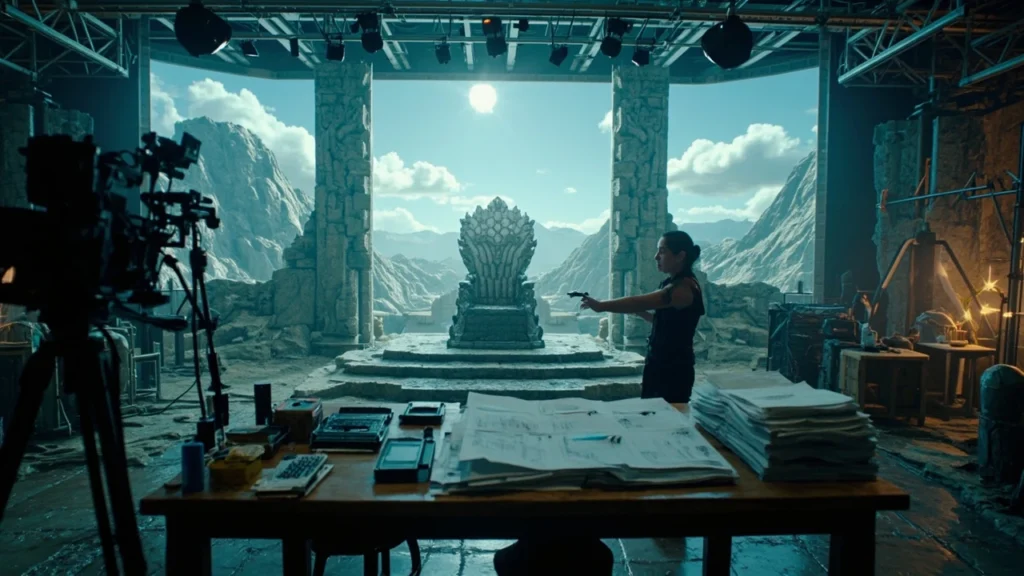
The single most discussed technical decision on rings of power season 3 is its continued use of virtual production. The show runs on a large LED volume in Auckland that is essentially a real-time rendering target: cameras move through a stage, and the background is generated live to match lens, focus, and parallax. The pipeline is built around Unreal Engine variants of in-camera VFX, with a heavy custom layer for color management and stage lighting.
What a game developer can actually reuse from this approach
The honest answer is: the ideas, not the assets. A small studio can adopt the same virtual scouting workflow on a much smaller LED wall, or even on a standard monitor, to block shots and previsualize cinematics. The real value of a virtual volume is that it forces the team to commit to a real-time render path early, which means cinematics, trailers, and in-engine cutscenes can be planned as a single asset class rather than three separate ones.
For a developer evaluating Unreal Engine 5’s camera system, the rings of power season 3 pipeline is a useful example of how the same render path can drive stage LEDs, in-editor previews, and final pixels. The cost is the usual one: asset fidelity, scene scale, and lighting have to be consistent across all three targets, which is a real engineering problem, not a marketing claim.
Calibration, latency, and the boring half of virtual production
The most useful part of any virtual production case study is the boring part: color calibration, genlock, latency budgets, and stage-to-editor handoff. These are the same problems a multiplayer game team solves when they want server-side camera replay to match a client view. The rings of power season 3 volume has to keep its LED render path within a few milliseconds of the camera’s exposure so that talent does not see a lag between the lens and the background. The engineering work to keep that latency stable is the kind of work that translates directly into a game’s netcode budget.
A team that wants to pilot virtual production for cinematics should expect to spend most of its engineering time on calibration, sync, and tooling rather than on the spectacular creative shots. The show’s public discussion of its volume has the same shape: most of the wins are invisible, and most of the visible wins are downstream of those invisible ones.
VFX and creature work: how high counts pressure the pipeline
Rings of power season 3 is unusual among prestige fantasy shows because its Second Age setting includes orc hordes, large-scale battle sequences, and a wide range of creature designs. Each of those categories has a different bottleneck: orc hordes are an instancing and crowd problem, hero creatures are a rig and groom problem, and environments are a hero-asset and scattering problem. The same three buckets exist in a typical AAA action RPG or strategy game, which is why the show’s pipeline notes are useful to read.
Crowds as a scaling test
Large battle sequences are essentially a crowd simulation test. The show has to render thousands of orcs at film-frame budgets while keeping each one readable on a 4K master. The standard answer is hierarchical instancing plus a small set of LODs, which is the same answer an Unreal or Unity team reaches when designing a battlefield scene. The interesting question is where the show’s crowd system diverges from a game’s: the show does not need player interaction, but it does need every individual to look good from any camera angle, which puts pressure on silhouette variation and material variation rather than on AI state.
For a game developer, the lesson is that the cost of “looking good in a screenshot” and the cost of “running in real time” are not the same. The show’s pipeline optimizes for the screenshot, then accepts whatever cost that imposes on render time. A game team’s pipeline has to do both at once, which is why mid-tier crowd systems so often break down at scale: the team picks LODs that look good in stills and discovers the runtime cost only when the scene is actually played.
Hero creatures and the retargeting problem
Hero creatures on rings of power season 3 are the equivalent of a game’s boss or signature enemy: they are unique rigs, unique textures, and unique animation sets, and they have to feel different from any other creature on screen. The cost is in the rig and in the animation library, not in the mesh. A troll or balrog-equivalent creature typically uses a layered rig with a custom deformation layer for skin sliding, muscle, and cloth, and a separate groom system for hair or fur. The same stack exists in modern engines, but the engineering depth is much higher on a show that has to render those rigs at film quality.
For a technical artist, the practical lesson is to invest in the rig and the deformation layer first, because no amount of texture work will save a creature that does not deform correctly. A show’s review team will catch a bad deformation in the first dailies; a game’s QA team often catches it much later, which is the only meaningful difference between the two pipelines.
Environment design and the problem of persistent worlds
A persistent world is the single hardest asset problem in both film and games, and rings of power season 3 carries that problem across multiple seasons. Locations like Númenor, Khazad-dûm, and the Southlands have to be visually consistent from season 1 to season 3 even as the art direction evolves and the camera team demands new angles. The equivalent in a game is a hub city or a signature biome that has to stay readable across several content patches.
Modular kits as the only honest answer
The industry-standard answer to persistent worlds is a modular kit: a small library of art-directed pieces that can be combined in many configurations, with a strict rule set for how they can be combined. The show’s art department almost certainly uses a kit of stone wall variants, door frames, roof pieces, and decorative trim that can be reassembled for new sets without rebuilding from scratch. The game’s biome team uses a similar kit for cliffs, trees, and ground decals.
The interesting decision is where to draw the line between modular and unique. Pure modular worlds feel repetitive; pure unique worlds are too expensive to maintain. Rings of power season 3 has to balance the same trade-off, and the show’s sets tend to follow a clear pattern: a kit of repeating pieces anchored by a small number of hero assets that are unique to a single location. That pattern is also the most common one in shipped AAA games.
Lighting as a continuity problem
Across For additional context, multiple seasons, lighting is the easiest place for a persistent world to drift. The show’s cinematographers have to match exposure, color temperature, and shadow direction across episodes shot months apart, often on different stages. The game equivalent is a day/night cycle or a weather system that has to remain stable across patches. The standard answer in both cases is a documented lighting bible with reference plates, calibrated monitors, and a small library of approved lighting setups. The show’s production team treats this as a craft problem; the game team has to treat it as an engineering problem because the lighting is interactive, not fixed.
Performance and scale: what game teams can learn from a film’s render farm
Render farm decisions for a show like rings of power season 3 are not directly applicable to a game team, but the underlying shape of the problem is the same. The show has a fixed deadline, a fixed render budget per frame, and a fixed scene complexity budget per shot. The game team has a variable deadline, a variable frame budget, and a variable scene complexity budget per player. In both cases, the team has to decide which scenes are allowed to be expensive and which scenes have to be cheap.
Cost-aware shot planning
On rings of power season 3, the VFX supervisor has to decide which shots are allowed to use heavy simulation, particle counts, or path-traced hair, and which shots have to be done on a faster path because they will be rendered thousands of times for a crowd or a battle. The same decision exists in a game: the team has to decide which scenes get full path tracing, which scenes get baked lighting, and which scenes get a low-cost impostor. The interesting difference is that the show’s team makes the decision per shot, while the game team has to make it per system and then live with the consequences when a designer requests an expensive combination.
The honest engineering lesson is that cost awareness has to move upstream. If a game team discovers at the end of a project that a particular combination of effects is too expensive, the cost of fixing it is high. If the show’s team discovers the same thing at the end of a season, the cost is even higher because dailies and editorial decisions are already locked.
Frame budget and review gates
Both pipelines use a frame budget, but the show’s budget is per shot and the game’s is per frame across the whole runtime. The review gate for a film is the dailies review; the review gate for a game is the performance pass. The interesting overlap is that both teams need a stable, well-understood review gate that produces a clear yes/no decision, and both teams suffer when that gate becomes a polite suggestion rather than a hard contract. Rings of power season 3’s public discussion of its production schedule is a useful reminder that the gate is more important than the toolchain.
Table: comparing rings of power season 3 production choices to game pipeline choices
The table below maps a few of the show’s publicly discussed production decisions to their closest equivalent in a game development pipeline. It is not a value judgment; it is a translation exercise so a developer can decide which ideas are worth borrowing.
| Production choice on rings of power season 3 | Closest game development equivalent | Main trade-off |
|---|---|---|
| Multi-season asset reuse plan | Live-service content roadmap with shared master assets | Stability of formats vs flexibility of new content |
| Virtual production LED volume | In-engine cinematic capture and virtual scouting | Calibration cost vs previsualization speed |
| Hierarchical crowd instancing for battle scenes | Massive entity counts in a real-time scene | Silhouette variety vs runtime cost |
| Hero creature rigs with layered deformation | Boss or signature enemy rigs with custom deformation | Deformation quality vs authoring time |
| Modular location kit for persistent sets | Modular biome or hub kit for persistent worlds | Variety vs maintenance cost |
| Documented lighting bible across seasons | Lighting and exposure system across patches | Continuity vs interactive flexibility |
| Per-shot render budget decisions | Per-system or per-scene performance budget | Creative ambition vs engineering headroom |
Table: what a developer should not borrow from a film pipeline
The previous table focused on what transfers. This one focuses on what does not, because borrowing a film technique without translating it is one of the most common ways game teams over-engineer their pipeline.
| Film pipeline habit | Why it does not transfer directly | What a game team should do instead |
|---|---|---|
| Fixed per-shot render budgets | Game scenes are interactive, not fixed shots | Build per-system budgets and validate per player scenario |
| Hand-authored lighting per scene | Game lighting must respond to player position and time of day | Use lighting systems that compose, not lightmaps that are baked once |
| Linear dailies review on a fixed calendar | Game content is reviewed in vertical slices and feature branches | Define review gates per feature, not per calendar week |
| Crowd simulation that only needs to look good from a camera path | Game crowds must survive any player angle and any interaction | Invest in silhouette variety, but budget for runtime cost |
| VFX passes that are re-rendered until the director approves | Game effects have to ship at a stable cost | Define a maximum effect cost and design within it |
Narrative, performance capture, and the dialogue pipeline
Rings of power season 3 is a dialogue-heavy show, and its narrative pipeline is closer to a cinematic game’s pipeline than its combat pipeline is. Performance capture drives both the acting and the facial animation, and the dialogue recordings have to be localized, edited, and conformed against the picture lock. The game equivalent is a cinematic workflow where voice performance drives facial animation, and localization has to be planned for from the casting stage rather than as a post-launch patch.
Performance capture as a data problem
On the show, performance capture is a data problem before it is an acting problem. The cameras have to be calibrated, the audio has to be clean, and the retargeting from the actor’s face to the digital character has to hold across the entire shoot. A game team that uses real-time face capture for its cinematics has the same problem, with the added wrinkle that the captured data has to be replayable in the engine without re-recording. The honest answer is that the data format is more important than the capture hardware. A clean, well-documented facial rig with a stable retargeting path will outlast several generations of capture tools; a fancy capture stage with a fragile rig will not.
The rings of power season 3 team, like most long-running productions, has converged on a small set of well-understood capture formats and a documented retargeting path. The same convergence is happening in the game industry around standard face rigs, and the teams that adopt a standard early tend to spend less on rework later.
Localization as a production gate, not an afterthought
For a show that ships globally on a streaming platform, localization is a production gate, not a post-launch task. Dialogue has to be timed to fit the picture, mouth shapes have to read across languages, and certain decisions about on-screen text have to be locked before picture lock. The same is true for a global game: localization has to be planned during the dialogue recording, not after, and certain UI strings have to be locked before a feature ships. The show’s schedule pressure is a useful reminder that this planning is what separates a localized title from a translated one.
A game team that treats localization as a translation task rather than a content design task will pay for it in UI redesigns, VO re-records, and font swaps. The same lesson applies to any content that is text-heavy, including quest text, item names, and accessibility strings.
QA, review, and the role of dailies in catching problems early
On rings of power season 3, the dailies review is the single most important quality gate. Every day, the previous day’s footage is reviewed by the directors, the VFX supervisor, the editor, and the showrunners. Problems that survive dailies tend to survive the entire season, because the cost of fixing them later is much higher. The game equivalent is the daily build review or the playtest review: a short, regular, high-signal meeting where the team looks at actual output rather than slides.
What a dailies culture actually requires
A useful dailies culture requires three things: a predictable cadence, a small set of reviewers with real authority, and a clear definition of “ship it” for the day. Without those, the review meeting becomes a status update, not a quality gate. The show’s dailies are credible because the reviewers can actually ask for a reshoot, a re-light, or a re-render, and the production plan absorbs the cost. The game equivalent is a lead who can delay a feature because the performance cost is too high, and a production plan that absorbs the cost without a public schedule slip.
For a small studio, the lesson is not to copy the meeting format but to copy the contract. The team has to know in advance that the reviewer’s decision is final and that the production plan will absorb the cost. Without that contract, the review is decorative.
Where QA and review overlap on the show and in the game
On the show, QA is split between creative review (does the shot tell the story?) and technical review (is the shot in focus, are the VFX clean, is the audio clean?). On a game, the same split exists between design review (is the feature fun?) and engineering QA (does it work at the budget?). Rings of power season 3’s separation of these two tracks is a useful model because it stops the two conversations from interfering with each other. A creative reviewer who also has to approve frame times is going to underweight one of the two; a performance reviewer who also has to approve the story is going to make a different mistake.
Risks, failure modes, and what happens when the plan slips
Any multi-season plan can slip, and rings of power season 3 is not exempt from the usual pressures: a writer’s room change, a director’s schedule conflict, a post-production delay, or a strike that halts production entirely. The interesting question is not whether the plan slips but how the production absorbs the slip. The standard answers are scope reduction, schedule compression, and post-production extension, and each one has a different cost.
Scope reduction as a controlled response
Scope reduction is the cleanest response to a slip because it targets the parts of the show that are easiest to cut: a small battle sequence, a single environment, a secondary storyline. The show’s producers can cut a set piece and still tell the rest of the season’s story. The game equivalent is a content cut: a planned feature is dropped, and the rest of the patch ships on schedule. Scope reduction is hard to do well because it requires an honest ranking of features by importance, and most teams do not maintain that ranking in a way that survives contact with a real slip.
Schedule compression and the cost of overtime
Schedule compression is the riskier response because it pushes the same amount of work into less time, which almost always lowers the quality of the output. The show’s VFX teams are particularly exposed here because their work is at the end of the pipeline. The game equivalent is crunch: the team works more hours, the same amount of work is done, and the resulting code is harder to maintain. Both industries know that crunch is a tax on future work, but both industries still pay it when the alternative is worse.
Post-production extension as a hidden cost
Post-production extension looks free because it does not delay the on-air date, but it is actually the most expensive response: the team has to maintain continuity across a longer period, vendors have to stay on retainer, and the editorial team has to keep working on a project that should already be done. The game equivalent is a long-running beta or a delayed patch that ships without the polish the team originally planned. Both responses look acceptable at the announcement and look much worse a year later.
What a developer can take into a Monday morning standup
Reading a production case study is only useful if it changes a decision the team is actually about to make. The list below is the smallest set of takeaways that survive the translation from a show’s pipeline to a game’s pipeline. None of them are novel on their own, but together they describe a posture that a small studio can adopt without new tools.
- Treat asset reuse as a planned capability, not a side effect. A stable master skeleton, a stable material library, and a documented retargeting path are cheaper to maintain than ad-hoc reuse across patches.
- Decide visual direction before content production starts. Late changes are always more expensive than they look, and a documented art bible is cheaper than a year of color drift.
- Move cost awareness upstream. A team that discovers a frame-time problem at the end of a feature is paying for a decision it should have made at the start.
- Run a real review gate, not a status update. The reviewers have to have the authority to delay a feature, and the production plan has to absorb the delay.
- Plan localization as content design, not as translation. VO timing, UI text, and font choice have to be locked before a feature ships, not after.
- Separate creative review from performance review. The two conversations have different costs and different outputs, and mixing them produces worse decisions on both sides.
Where the comparison breaks down
The comparison between a film pipeline and a game pipeline is useful, but it has limits. A show ships a fixed number of frames to a fixed audience on a fixed date; a game ships a system that has to run on a wide range of hardware for an unpredictable amount of time. The show’s review cadence is daily; the game’s review cadence is per feature. The show’s assets are consumed in order; the game’s assets are consumed in any order the player chooses. Any team that tries to import a film pipeline without translating those differences will end up with a toolchain that fights the game, rather than one that supports it.
The honest answer is that rings of power season 3 is a useful reference, not a template. The show’s decisions are interesting because they are documented and because they have to survive real production pressure. The game’s decisions are interesting for the same reason. The two pipelines have a lot to teach each other, and the lessons that transfer are the ones about discipline, review gates, and cost awareness. The lessons that do not transfer are the ones about fixed output, fixed audience, and fixed schedule.
Frequently asked questions
Is rings of power season 3 a real production, and is it confirmed?
Yes. Amazon Studios has been publicly developing the series across multiple seasons, and the production has been discussed by the showrunners, the directors, and the visual effects vendors. This article treats the production as a documented case study and uses the publicly reported pipeline decisions to compare against a typical game development pipeline. Any claim that goes beyond what has been publicly reported is either flagged as uncertain or framed as a general pipeline practice rather than a verified fact.
Does rings of power season 3 actually use a real-time engine for its virtual production?
The show’s virtual production volume is built on real-time rendering, and the same family of tools that drive in-engine cinematics in game development also drives the on-stage LED walls. The exact engine and the exact toolchain are production details that the show’s team has discussed in broad terms, but the engineering shape of the pipeline is similar to a real-time cinematic workflow. For a developer, the useful point is that the same render path is used for stage LEDs, in-editor previews, and final pixels, which is the same pattern a game team uses for cinematics.
Why is rings of power season 3 useful as a GameDev case study?
The show is useful because its production decisions map onto game development decisions in a way that is easy to compare: multi-season asset reuse, virtual production, crowd scaling, hero creature rigs, persistent environment kits, performance capture, and review gates. Each of those topics has a direct equivalent in a game pipeline, and the show’s public discussion of its production is detailed enough to be a useful reference without being so specific that it stops being a general lesson.
What is the single most transferable lesson from rings of power season 3?
The most transferable lesson is the value of a stable, well-understood review gate. The show’s dailies review is a contract between the reviewers and the production plan, and the game’s review gate has to be a similar contract. Without a real review gate, the team’s quality decisions become negotiations rather than engineering choices, and the cost of those negotiations is paid later in the project.
Should a small studio invest in virtual production?
Probably not at the scale rings of power season 3 uses, but the ideas transfer. A small studio can use a real-time engine for virtual scouting, in-engine previsualization, and cinematic capture without an LED wall. The cost is much lower, and the engineering work is the same: calibration, sync, and a stable render path. The studio should expect to spend most of its time on the boring engineering work and very little on the spectacular creative shots, which is the same trade-off the show’s team has made.
How does the show’s creature work compare to a game’s boss design?
Both pipelines start with a layered rig, a custom deformation system, and a separate groom or hair system. The show’s review team catches deformation problems in the first dailies, while a game’s QA team often catches them much later. The honest lesson is to invest in the rig and the deformation layer first, because no amount of texture work will save a creature that does not deform correctly. The same principle applies to a game’s signature enemy or boss.
What about performance: is the show’s render farm a useful comparison?
The shape of the problem is the same: a fixed deadline, a fixed budget per output, and a fixed scene complexity budget. The difference is that the show’s output is per shot and the game’s output is per frame across the whole runtime. Both teams have to decide which scenes are allowed to be expensive, and both teams suffer when that decision is made late. The show’s per-shot cost decisions are a useful model for a game’s per-system cost decisions, even though the technical implementation is very different.
Are there any production details that are not useful to a developer?
Yes. The show’s casting decisions, its marketing schedule, and its streaming platform strategy are not useful as a game development reference. The article deliberately avoids those topics because they do not transfer. The useful lessons are the ones about pipeline discipline, asset reuse, and review gates, and the rest of the production is treated as context rather than as a template.
How does this compare to other production case studies in game development?
Rings of power season 3 is a useful complement to the usual game-only case studies because it documents a real-time cinematic pipeline at a different scale and on a different schedule. The lessons overlap, but the framing is different: the show’s team optimizes for a fixed output on a fixed date, while a game team optimizes for a variable output over a long lifetime. Reading both kinds of case studies is more useful than reading only one, because each one surfaces a different failure mode.
What would change this analysis if new information becomes available?
Any new public detail about the show’s actual toolchain, its actual render budgets, or its actual review cadence would sharpen the comparison. If Amazon Studios publishes a deeper post-mortem, the case study can be updated with verified numbers rather than general pipeline practice. Until then, the article stays at the level of patterns rather than verified claims, which is the appropriate level for an external reader who has not seen the production’s internal documents.