About Valorant Ranks – System, Co-op, Distribution of Points

The System of Valorant Ranks – The Competitive Mode
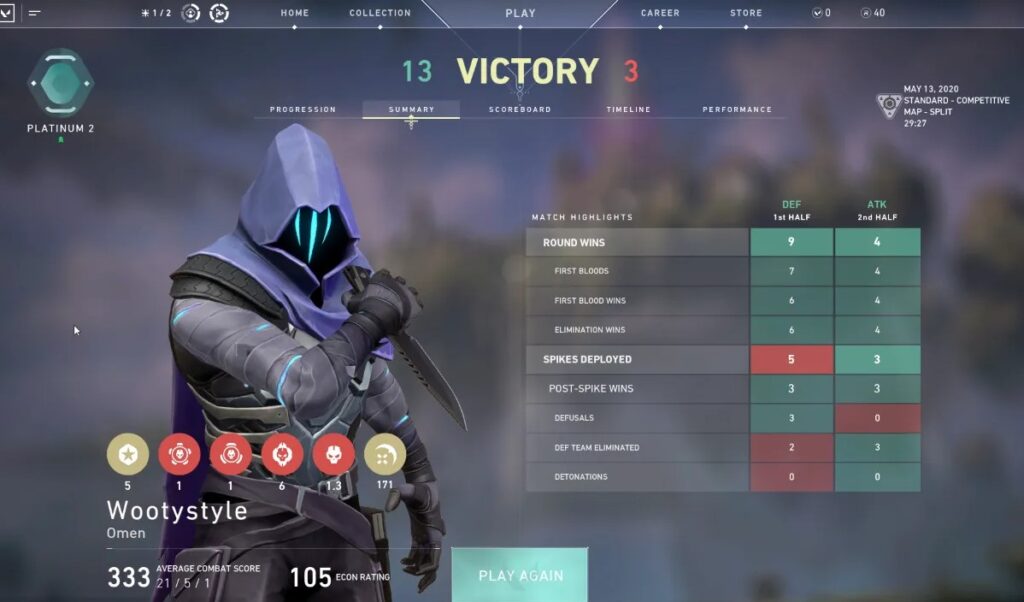
The Competitive mode (also known as Ranked) is where Valorant’s PvP battles get serious. While the gameplay of the Ranked mode mirrors the Unrated mode with the same 5v5 setup, Agent selection, and round objectives, the stakes are definitely higher for the Ranked matches. To climb these premium Valorant ranks, you need to understand how this mode works. Let’s start by reviewing the major rules of Competitive mode.
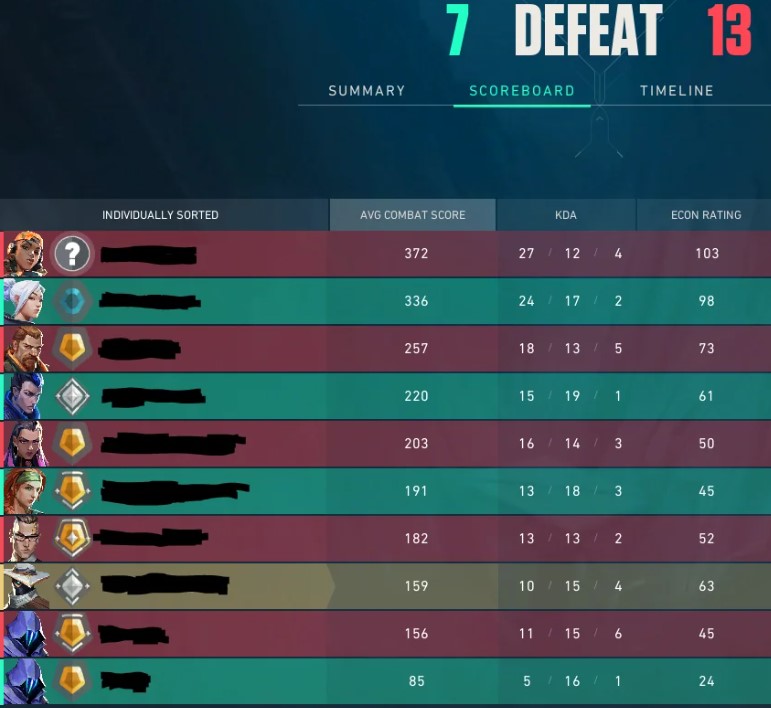
In Competitive mode matches, two teams face off – one on Attack, one on Defense. The goals are for the attackers to plant the spike, and/or to eliminate the defenders, while the defenders’ tasks could be either stopping the spike from going up or defusing it when active. Players have 30 seconds into each round where they may spend money on weapons and skills. Rounds last 100 seconds which goes down to 45 seconds if the spike has been planted. Whichever team reaches 13 first wins the game, and at the 12-round mark, teams switch sides.
If the match is drawn at 12-12, the game proceeds to Overtime. In this extra time mode, there are 2 sets of rounds when both teams have one in Attack and one in Defense, played for 5,000 credits (each). Ultimate skills are activated quickly. The Overtime repeats until one team manages to win both rounds or most players vote for a draw.
The Competitive mode requires a unanimous vote to surrender, unlike the 80% in Unrated. Besides, getting into the Competitive mode needs, at least, an account level of 20 or higher to enter.
In a case, you want to test your skills in the Valorant’s Competitive mode, prepare that it is going to test your skill, strategy, and endurance. Every decision counts in the Competitive mode. We recommend checking our ultimate Valorant tier list of agents to choose the best class for the Ranked mode.
What Are the Ranks in Valorant – Explanation of Competitive Tiers
There are 9 Competitive ranks in Valorant. Besides Radiant, each rank has 3 tiers: 1, 2, and 3. Examples of this would be Iron 1 as the very lowest rank players can get in the game, while Iron 3 is the best one in the Iron ranks. Once you climb your way past Iron 3, you move into Bronze 1, etc.
These are all Valorant ranks that you can get while playing the Ranked mode:
- Iron (1, 2, 3). The starting point for most new players. The gamers with the Iron rank are still learning the basics of the game – from aiming to map awareness;
- Bronze (1, 2, 3). This rank includes players who are more aware of the mechanics, have a lot of inconsistency in their gameplay and in their team coordination;
- Silver (1, 2, 3). Players develop their skills and become a better aimer. They will learn basic tactical skills but still commit many mistakes;
- Gold (1, 2, 3). More strategic abilities of the players and team-focused mindset are developed in Gold, though this rank can also be very much a hotbed for toxicity, as competitiveness rises;
- Platinum (1, 2, 3). Serious about climbing, making better decisions, solidly grasping how to play games;
- Diamond (1, 2, 3). High mechanical skills, and great teamwork; these players can often carry matches with their knowledge and skills;
- Ascendant (1, 2, 3). Really close to the pro level, with the top aim and strategy, probably just lacking some coordination at an elite level;
- Immortal (1, 2, 3). Immortal is a very prestigious rank in which players have near-perfect game sense and skill, controlling matches with ease and precision;
- Radiant (No tiers). Radiant is the highest among Valorant ranks that defines the most skilled players in the world. Most Radiant players are often in the top 500 in their region, with pro-level mechanics and game knowledge;

You have to play 5 placement matches to get yourself into the ranking system. Later on, you get placed into a rank based on your performance in those matches. Of course, as you win or lose matches, you gain or lose rank rating (RR). This rating dictates where you move within the premier ranks in Valorant.
To learn more about Valorant ranks, you can also read the following Reddit thread where gamers discuss the differences.
About the Valorant Ranks Distribution
Valorant’s rank distribution reflects the struggle of those players who are making their way upward through the competitive ladder. Each month this distribution slightly changes. The majority of the player base is still packed within the lower to mid-tier ranks, lying between Silver and Gold. Both combine for almost half of the players.
This is the distribution of Valorant ranks as of September 2024 (V8.03):
- Iron – 7.47% of players;
- Bronze – 18.7%;
- Silver – 23.05%;
- Gold – 21.63%;
- Platinum – 14.79%;
- Diamond – 9.26%;
- Ascendant – 4.25%;
- Immortal – 0.78%;
- Radiant – 0.023% of top 500 players (per region);
According to recent statistics, the Valorant ranks percentage is distributed in such a way – most of the players drift between the ranks of Bronze to Platinum, while ranks such as Ascendant, Immortal, and Radiant are a lot more difficult to reach.

Only about 5% have received the Ascendant or above ranks. Among those who will try and strive to reach as high as Radiant, competition will be extremely tough. Only a small handful of gamers sit at the Valorant premier ranks. You can track down the Valorant rank distribution in real time using this fan-made website.
What is the Valorant Ranks Rating (RR)?
The RR is short for the Rank Rating. It shows how the gain or loss of ranks in Valorant works after each Competitive match. Your RR gain or loss depends on your win/loss record and individual performance. Usually, you gain 5-50 RR if you win a game and lose 0-30 if you lose. Higher ranks tend to gain less RR with a win and lose more RR with a loss, which makes it harder to climb.
When you hit 100 RR in your tier, promotion to the next tier will start you out at a minimum of 10 RR in that new tier. On the other hand, when you fall to 0 RR and then lose a match, you may get demoted back to the previous tier. But at least you will have 70 RRs in the lower tier.
RR becomes even more competitive for players in the Immortal and Radiant ranks. Earning more than 100 RR will allow players to climb the rankings ladder.
The required RR threshold to reach Radiant is different in each region:
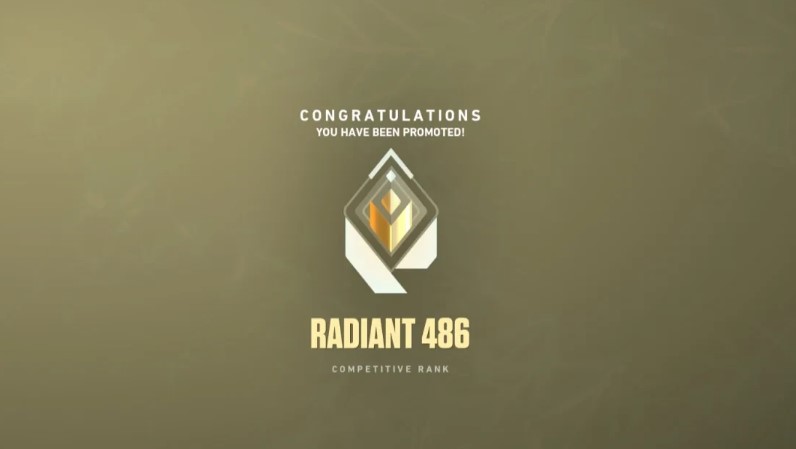
- North America – Immortal 2 (90 RR), Immortal 3 (200 RR), Radiant (450 RR + Top 500);
- Europe – Immortal 2 (100 RR), Immortal 3 (200 RR), Radiant (550 RR + Top 500);
- LATAM/KR – Immortal 2 (90 RR), Immortal 3 (150 RR), Radiant (200 RR + Top 500);
- APC – Immortal 2 (80 RR), Immortal 3 (200 RR), Radiant (400 RR + Top 500);
- BR – Immortal 2 (100 RR), Immortal 3 (230 RR), Radiant (340 RR + Top 500);
What is MMR in Valorant?
Since the official Riot’s explanation about matchmaking in Valorant is pretty vague, we decided to explain a bit more with certain details. MMR means the Matchmaking Rating. It is the Valorant’s background system used to help determine your skill level in comparison with all other players.
Unlike the Rank Rating, which you can see at the end of each match, MMR works in the background and plays an important role in how you climb up the Valorant ranks. While MMR and RR are both associated with your Act Rank, the MMR system decides who should be matched with and against you.
Riot describes MMR as a “big invisible ladder” when each player occupies an individual position according to the individual gaming performance. It gets updated every time you either win or lose any match.
Sometimes your visible rank will not reflect your actual hidden MMR:
- If your MMR is higher than your current rank, you’ll gain more RR for wins and lose less for losses;
- You are losing more RR on losses and gaining less when you win if your MMR is lower than your rank;
While you can’t see your MMR, the goal is simple: winning as many games as possible while holding a positive win rate will increase both their MMR and RR. Match performance directly affects the amount of RR earned.

How to Get into Valorant Ranks – Acts and Episodes
Every new Act in Valorant comes along with a rank reset. All players must go through at least a single placement game to return to the ranks. It takes a previous Act rank as a starting point but may shift based on how well or poorly you did in that single match. However, placement games do not affect the Act Rank progress. RR by 90% for players in Immortal and Radiant, and Radiant players are demoted to Immortal on an Act reset.
When a new Episode starts, the reset system gets deeper. Players will have to play 5 placement matches and usually end up a couple of tiers lower than where they finished the prior Act.
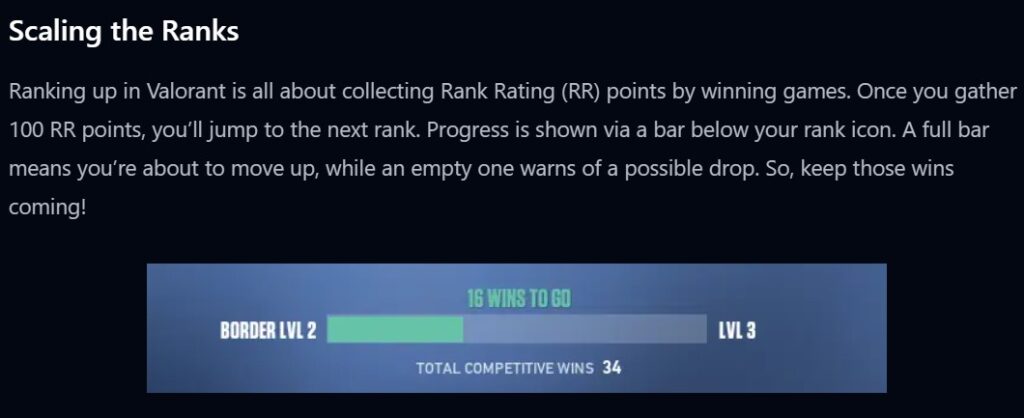
The Act Rank follows your skills over an Act and keeps a recording of the highest-ranked win and the total number of wins during the period of the Act. After each win, a triangular graphic filled with small triangles reflects each of those wins by filling a huge triangle. Higher-ranked wins will push the lower-ranked triangles out. The border on the graphic upgrades at key milestones, such as 9, 25, and 50 wins.
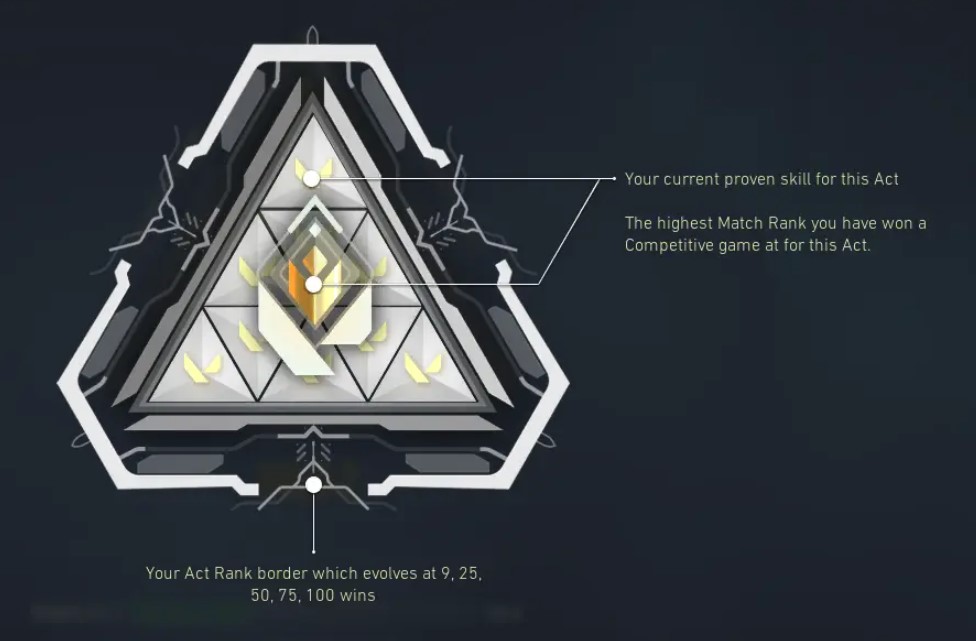
After an Act, your best rank is saved as a badge, and at the end of an Episode, players will get a special buddy matching their highest Act Rank.
How to Unlock Valorant Ranked Mode – Placement Games
The Ranked Competitive mode in Valorant unlocks after players have reached Account Level 20. Riot Games launched this system to make sure players had a certain level of experience before reaching the Ranked mode. Also, the introduction of placement matches in Episode 4 of Act 1 reduced the amount of “smurf” accounts.
Players can earn XP to level up to Level 20 in other non-competitive Valorant game modes like Unrated or Spike Rush.
Once this mode is unlocked, you have to play 5 placement matches that determine your rank. The game will analyze your skill throughout these games. It takes your casual MMR as the default point. The better you do in these games, the higher your starting rank is going to be. People who do really well and win a lot of their placement matches can start as high as Gold or Platinum ranking.
For returning players who had attained an Immortal or higher rank in the previous season, their possible highest rank after placements will be Ascendant 1.
What Ranks Can Play Together in Valorant – Party Restrictions
Unfortunately, you can’t just play with any of your friends in the Ranked mode. Competitive party restrictions make sure that no players are severely outmatched by the other teammates.
That is why all players must fall into certain rank categories:
- Iron & Bronze. These ranks can queue with any player ranked Silver but not higher than Gold;
- Silver. This rank can play with Iron, Bronze, and Gold players. However, they can’t queue with Platinum or higher;
- Gold. Can queue with Silver and Platinum players, but not with Diamond or higher;
- Platinum. Players of this rank can play with Gold and Diamond players but can’t queue with Ascendant or higher unless the difference is only one tier;
- Diamond & Ascendant. Can queue with one tier higher or lower. The explanation goes that for instance, Diamond 2 can queue with Platinum 2 or Ascendant 2;
- Immortal. Unable to queue with anyone more than one tier or in a full five-stack group. Immortal players can’t queue with Diamond, Platinum, or any other lower ranks unless they come in a full group;
- Radiant. Such players can only queue in a five-stack with other queue players. Radiant will take RR penalties for playing with people of a lower rank;

There are also certain party size rules:
1) Five-Stack Teams
No rank restrictions, but parties get RR penalties depending on the rank difference in the group; this ranges from 25% to 90%.
2) Four-Player Groups
Queuing into Ranked is forbidden to avoid unfair situations whereby solo players might be matched against strongly coordinated groups.
3) Two or Three-Player Teams
Must be within the above rank restrictions.
What do you think about such restrictions for the players who want to gain Valorant ranks along with friends?
Additional Tips about Getting Valorant Ranks
- Focus on wins. Work on team playing and strategy for more wins, especially against players of a higher rank than yourself;
- Keeping the in-game stats as high as possible, like kill/death ratio and damage dealt, will grant influences on RR gained after wins and reduce RR loss after defeats;
- Consecutive wins, especially with dominant performances, are a pretty strong signal to the ranking system that your current rank is too low. This might lead to higher RR gains and help you rank up faster;
- Try to end each Act or Episode at a higher rank compared to the one before. Not only will this help solidify progress, but it also affects where you will start once a rank reset occurs in the next Act;
- Avoid AFK penalties. Inactive players for more than 3 rounds receive an RR penalty of 8-12 points; this value increases with the amount of rounds missed. If you have been inactive for 6+ rounds, you receive the maximum penalty, even on a winning team;
- Dodging from a Competitive match lobby results in a small RR loss. Try not to dodge from lobbies, because with time, these can add up in penalty;
- Warm-up before matches. Doing regular warm-ups will definitely sharpen your crosshair. Try this routine: kill 200-250 bots in range. Play 2-3 Deathmatch games. An extra match of Team Deathmatch, Spike Rush, or Swiftplay;
- Regular daily practice builds up your skills in shooting, movement, strategies, and map knowledge. The more you play, the more solid your overall gameplay will be;
- Try playing for different Agents. Jett and Raze are the kind of duelists who can go full ham, while Sage and Skye are supports who can help heal and support your team. Brimstone and Killjoy can control maps, and sentinels, such as Cypher and Killjoy, provide more tactical gameplay;
If these tips seem irrelevant or insufficient, then do not forget to watch the great YouTube video, where the experienced blogger gives his advice.
Frequently Asked Questions
What rank am I supposed to be before playing ranked?
To participate in ranked gameplay, a player should have reached account level 20.
What is Leaderboard in Valorant?
The Valorant leaderboard shows the best of the best players, ranked by rank and performance. This system was introduced in Episode 2. To be able to appear on the leaderboard, players must have completed a minimum of 50 competitive matches and continue playing at least one match per week to sustain their rank within it. A player’s rank and rating also show up on the leaderboard along with the player card. The Career tab keeps track of overall competitive progress, including recent match statistics.
What is the most common rank in Valorant?
Silver is the most consistent rank in Valorant, according to the distribution of Valorant ranks. Sometimes, Gold may take over and become the most common rank, but Silver stays as the skill ranking where most of the player base resides.
Does my rank reset in Valorant?
Yes, your rank resets at the start of each new Act or Episode. Each time a new Act starts, one would have to play one placement match to be ranked again, usually close to his previous ranks in Valorant. When an Episode starts, you are forced to play 5 placement matches in the ranked games. Additionally, if a player doesn’t play ranked for 2 weeks, then their rank is temporarily hidden from view until they play again.

Can a Bronze player play against a Gold player in Valorant?
The Valorant ranks system mainly doesn’t allow the player to queue with players with ranks other than Silver. Still, when they are in a five-player group, the rank restrictions become less strict, and you can team up with players of differing ranks. In five-stacked teams, there is a 25% RR penalty if the ranks differ too much. It means you will earn or lose fewer RR points compared to regular matches.
Are CSGO and Valorant ranks the same?
No, CSGO rank and Valorant rank refer to different ranking systems. Both games use competitive ranking to tell how good a player is. When comparing CSGO ranks to Valorant, you will quickly find out that their ranking structure, tiers, and ways of progression are completely different. CSGO has 18 different ranks that start from Silver 1 to Global Elite. In its turn, Valorant has 9 ranks, starting with Iron to Radiant.
Conclusion
The system of Valorant ranks offers players a chance to compete across various skill levels. From beginners learning the basics to Radiant-tier experts, each rank shows individual growth and highlights where you need to improve your skills. Stay focused, sharpen your skills, and remember—teamwork is essential for climbing the Valorant ranks’ ladder.