VR Game Development Companies: How to Evaluate the Right Studio
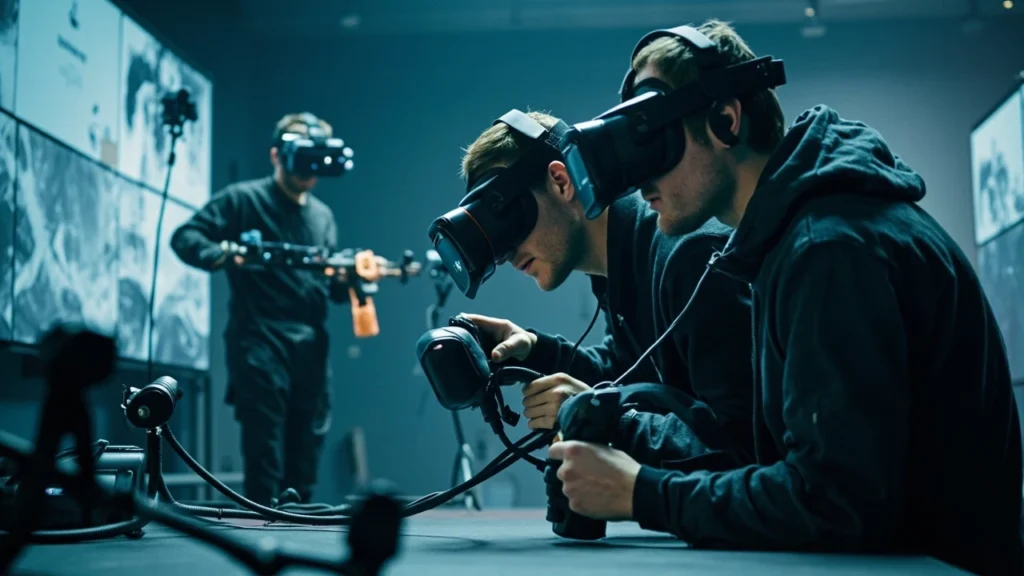
VR game development companies: choose by evidence, not promises
Choosing a VR studio is not an exercise in finding the most impressive concept reel. A headset project can look fluid in a promotional clip and still fail when the final build drops frames, loses tracking, becomes uncomfortable to use, or exceeds the performance budget of the target device. The right partner is one that can explain those constraints in technical terms, show working evidence, and assign clear ownership for every part of production.
This guide is for studio leads, producers, publishers, and technical teams evaluating VR game development companies. It provides a structured way to compare capability across interaction design, art, engineering, optimization, platform QA, and delivery. Rather than presenting a ranked directory, it focuses on the evidence you should request, the questions that expose hidden assumptions, and the milestones that turn an uncertain business case into a production plan.
What should a VR development partner be able to demonstrate?
A capable partner should be able to demonstrate more than headset knowledge. It should connect the target hardware, interaction model, session length, player population, and production scope to a clear technical strategy. A prototype can prove that an interaction is promising. A shipped or production-ready build proves that the team can also handle integration, optimization, testing, platform requirements, and release preparation.
Evaluate evidence in this order:
- Target-platform fit: Can the studio explain the intended headset, operating system, controller set, tracking configuration, and delivery method?
- Interaction fit: Has the team built and tested the kind of interactions central to the project, such as direct manipulation, room-scale movement, seated play, hand tracking, or mixed reality?
- Production maturity: Can it show a build with repeatable behavior, managed assets, stable performance, and documented trade-offs?
- Technical ownership: Does the proposed team include engineering, art, design, QA, and production rather than treating those disciplines as interchangeable?
- Delivery control: Can the team define milestones, acceptance criteria, review gates, dependencies, and change control?
A strong demo answers a narrow question with control. It should identify the device used, the build date or version, the test conditions, and which content was simplified. If a studio cannot distinguish its production work from prototypes, optimization experiments, or licensed showcase content, ask for a project-level explanation before treating the footage as comparable evidence.
| Evaluation area | Evidence to request | Warning sign |
|---|---|---|
| Interaction design | A playable slice showing reach, grab, locomotion, UI, and comfort behavior | Only prerecorded headset footage or interactions designed for a mouse |
| Performance | Frame-time and memory measurements on named target hardware | Unqualified claims about smoothness or device capability |
| Platform readiness | Store submission planning, permissions, save data, and entitlement handling | No discussion of platform requirements or certification risk |
| Production delivery | Milestones, owners, review artifacts, and acceptance criteria | Scope, schedule, and responsibilities remain undefined |
| Maintenance | A support model covering defects, updates, and platform changes | The offer ends at an untested prototype |
How to compare studio capabilities against your VR project
The most useful comparison starts with your project, not the provider list. Write down the target device, expected session length, interaction model, art direction, multiplayer or simulation requirements, content volume, release date, certification constraints, and post-launch responsibilities. These inputs let you ask each candidate to work from the same problem.
Then separate capabilities that are mandatory from those that are merely useful. A training simulation may need accurate object behavior and reliable deployment. A location-based entertainment title may need durable unattended installation behavior. A multiplayer game adds identity, synchronization, moderation, and server operations. A consumer title may place more emphasis on onboarding, comfort, visual fidelity, and store discovery.
| Project requirement | Relevant studio evidence | Best proof artifact |
|---|---|---|
| Standalone headset release | Mobile GPU budgeting, thermal behavior, local persistence, and platform submission planning | Production-like build tested on the intended device family |
| PC VR release | Render-feature support, hardware matrices, configuration testing, and scalable settings | Documented compatibility and performance test matrix |
| Room-scale interaction | Clearance handling, reachability, occlusion, locomotion, and physical safety | Playtest session with design rationale and observed failure cases |
| Multiplayer VR | Host authority, latency handling, pose synchronization, cheating boundaries, and session recovery | Network test with documented connection conditions |
| Training or simulation | Content accuracy, assessment logic, reporting, deployment, and user management | End-to-end workflow demo tied to the real use case |
| Art-heavy showcase | Environment art, character work, shading, animation, and visual optimization | Art review that identifies device and pipeline constraints |
Do not compare every provider against every requirement. A studio may have deep expertise in one part of the project and partner elsewhere for another. The key is to know which capabilities are essential, which can be covered by the lead studio, and which require a named specialist. Ownership must remain clear even when several companies contribute.
What should a VR prototype prove?
A VR prototype should reduce a specific production risk. It is not a miniature version of the finished game. Its purpose is to make an expensive assumption testable before the team commits to a broad production pipeline.
For example, a prototype may test whether a two-handed assembly mechanic remains comfortable in a standing session, whether a virtual workbench can be reached reliably, or whether networked object ownership stays stable under realistic latency. It should include enough surrounding behavior to reveal whether the interaction works, but it does not need final art, full content, or every planned system.
Ask the studio to document the hypothesis and acceptance criteria in advance. A useful prototype brief contains:
- The interaction being tested and the player context.
- The target device and expected play space.
- The build configuration used during the test.
- The measurable or observable pass condition.
- The known omissions and the limits of the conclusion.
A production partner should also explain how prototypes enter the main build. Assets that cannot scale, scripts that depend on temporary scene logic, and performance tests performed only in an isolated branch can create false confidence. The best handoff is a documented, maintainable slice with known costs.
How to review performance evidence without relying on vague claims
Performance questions need context. “Optimized for VR” says very little because the result depends on the device, resolution, render features, scene, workload, and test conditions. Ask what was measured, on which hardware, and against which objective.
Useful evidence includes frame-time distributions, CPU and GPU timing, memory use, draw-call or batching information where relevant, load behavior, thermal behavior during sustained sessions, and results from the most demanding representative scenes. A studio should also explain which compromises it would make if the frame budget is exceeded: resolution, effects, object density, shadow quality, audio complexity, simulation rate, or content scope.
Playback smoothness is not the only criterion. The experience must remain visually stable and comfortable, respond predictably to input, avoid persistent stutter, and maintain correct spatial relationships. A high average frame rate can conceal hitches that disrupt interaction, while a low-resolution scene can still be too heavy if CPU work is excessive.
| Performance evidence | What it tells a producer | What it does not prove |
|---|---|---|
| Average frame rate | General workload viability under stated conditions | Absence of spikes, long-session heat, or tracking instability |
| Frame-time graph | Consistency and the location of expensive moments | That every scene or interaction performs similarly |
| CPU and GPU breakdown | Which side needs engineering and art attention | A final optimization plan without representative content |
| Target-device test | Behavior on intended hardware | Performance across every device or configuration |
| Load and recovery test | Readiness for level transitions and failures | Complete content-scale validation |
Request a repeatable test method. The studio should record device model, runtime version, application build, scene, observation period, input configuration, and any known anomalies. That level of detail makes the result reviewable and gives the production team a baseline for regression testing.
Which production services need explicit ownership?
Full-cycle VR development often includes concept, game design, 3D art, interaction design, engineering, spatial audio, networking, QA, platform work, and live operations. A provider may describe all of these as a single service, but the proposal should identify accountable leads and the dependencies between disciplines.
Do not assume that technical art, level design, multiplayer engineering, and platform QA will be handled by the same person. In a small team, roles can overlap, but artifacts still need owners. A visual asset needs technical validation in the target engine. A comfort feature needs a test method. A network feature needs a threat and failure model. A store release needs a submission owner.
- Design: Owns the interaction model, progression, onboarding, and functional requirements.
- Engineering: Owns runtime behavior, integration, optimization, save data, networking, and technical debt.
- Art and technical art: Owns assets, materials, animation, rendering, and pipeline constraints.
- QA: Owns test strategy, coverage, defect reproduction, and regression checks, while design and engineering retain feature ownership.
- Production: Owns scope, schedule, dependencies, risk, communication, and change control.
- Publishing or platform lead: Owns store materials, account requirements, submission, release configuration, and post-release coordination.
A good proposal identifies where the client participates. If discovery, design, and certification approval are treated as invisible studio responsibilities, milestones will be unclear. If every decision requires the client to specify implementation details, the studio is not providing meaningful production ownership.
How do you compare cost, rates, and commercial models?
Price is a consequence of scope, risk, team composition, and delivery model. Comparing hourly rates alone can reward the wrong answer. A lower rate multiplied by uncertain hours may cost more than a higher rate with a clear estimate, defined milestone, and controlled change process.
The market snapshot linked above reports a median hourly rate of $37 across the listed VR category as of October 2026. That figure is useful as broad context, not a quote for an individual project. Rates vary by region, discipline, studio scale, engagement length, and the risk of the work.
One external market snapshot can help show the range of available suppliers. For additional context, Goodfirms’ 2026 VR developer listing describes a broad market that includes studios focused on PC VR, standalone headsets, mobile VR, mixed reality, training, simulation, and entertainment. That breadth means the useful comparison is rarely “Which company is best?” It is “Which company has solved problems comparable to mine, and can it prove the result?”
Compare proposals on the same basis:
- List included disciplines and named responsibilities.
- State the expected duration and milestone assumptions.
- Separate discovery, prototype, production, QA, certification, and support costs.
- Define what triggers additional work and who approves it.
- Identify ownership of code, source assets, reusable tools, and project documentation.
- State the payment schedule and conditions for accepting deliverables.
| Commercial model | Best fit | Main risk |
|---|---|---|
| Fixed scope | Well-defined content, milestone, or deliverable with stable requirements | Unclear scope can turn the fixed price into dispute and scope churn |
| Time and materials | Discovery, uncertain prototypes, or evolving production | Weak cost control if milestones and decision rights are vague |
| Blended team | Long production needing several disciplines | Team changes and unclear ownership can reduce continuity |
| Milestone-based contract | Projects with testable acceptance criteria | Criteria must be precise enough to prevent subjective acceptance arguments |
Regardless of model, the contract should explain change control. What happens if a headset target changes after optimization begins? How are new platforms handled? Which requests count as defects, feature changes, or new scope? A commercial model is useful only when responsibility remains visible.
What should a VR studio’s QA and platform plan cover?
VR QA combines software correctness, hardware behavior, comfort, tracking, and the experience of a room. A headset build can pass conventional functional checks while still feeling unstable or causing avoidable fatigue. The test plan should therefore cover both technical acceptance and player-facing risk.
Ask the studio which devices and configurations it will test, who owns compatibility, and how frequently builds are promoted to QA. It should also state how defects are prioritized. A crash or save corruption may require immediate attention, while a minor visual issue can have a different release threshold.
- Functional coverage for progression, inventory, saves, settings, onboarding, and failure recovery.
- Tracking tests for controllers, hands, boundary behavior, focus, pose transitions, and space resets.
- Input coverage for supported control schemes and accessibility options that are in scope.
- Performance checks on representative devices with repeatable recording conditions.
- Comfort review for locomotion, camera movement, interaction reach, and session duration.
- Network tests for latency, loss, reconnection, timeout, and synchronization errors where applicable.
- Submission preparation and validation against current platform requirements.
Development testing is not the same as certification. A team can complete its own regression suite without guaranteeing acceptance by a platform holder. The proposal should distinguish internal release readiness, formal submission, and any certification or review process required for the intended release.
How should art, interaction, and comfort be evaluated together?
VR art direction cannot be reviewed as a collection of still images. Scale, lighting, text readability, occlusion, hand relationships, movement, and spatial audio all affect whether an image remains usable in a headset. The strongest review uses the real player perspective, the intended device, and representative content.
Ask whether visual references were captured at the intended field of view and distance. A polished render created for a flat screen can misrepresent how a control panel or text element will appear in VR. If motion, transparent surfaces, particles, or post-processing are central, request a build rather than a montage.
Comfort evaluation also requires context. A movement technique that is suitable for seated simulation may be unsuitable for a room-scale title. Rapid camera motion, fixed-pivot turns, forced camera motion, and frequent reach beyond the player’s space can change fatigue and safety. The studio should connect these choices to the design goal, test them with users, and document the accepted trade-offs.
For related context on broader immersive production, see how universities and gamification apply interactive systems to structured learning and participation. That page addresses a different use case, but the underlying lesson remains relevant: an interactive system succeeds when its mechanics match the environment and audience rather than when technology is added for its own sake.
What red flags should appear during a VR studio evaluation?
Most selection problems become visible before a contract is signed if the evaluation is organized. A studio that cannot explain its assumptions may still produce good work, but the client will have difficulty judging changes and accepting deliverables. Watch for unsupported claims, unclear ownership, and demo material without a stated purpose.
- No target device: The proposal discusses “VR” without naming the headset, runtime, controller model, or operating system.
- No performance context: Smoothness is promised without hardware, build version, scene, or measurement method.
- Prototype presented as proof: A short clip is used to imply that every production concern has been solved.
- Platform work is invisible: No one owns submission, permissions, saves, account flow, or compatibility.
- Unclear deliverables: A milestone ends with “working VR experience” rather than defined features and acceptance criteria.
- Unlimited revision: The agreement does not distinguish feedback rounds from new scope.
- No source handoff: The client receives a binary but not editable project files, assets, documentation, or build instructions.
- Post-launch support is undefined: Defects, content changes, platform updates, and live operations have no owner.
One missing answer does not always disqualify a studio. A smaller team may not have shipped every kind of VR project but may have a sound method and credible specialists. The important question is whether the team knows the limit, can explain how it will close the gap, and is willing to make that dependency explicit in the plan.
How do you run a productive VR studio evaluation?
A structured evaluation should produce comparable evidence. Give each candidate the same project brief, request the same artifacts, and give them enough time to inspect the problem before pitching. This reduces the chance that a polished presentation wins over a better production fit.
- Send a written brief: Include target hardware, core interaction, session length, content assumptions, business goal, schedule constraints, and delivery expectations.
- Request an initial response: Ask for relevant work, named team roles, a discovery plan, major assumptions, and questions that must be answered before estimation.
- Run a technical and design review: Discuss interaction comfort, technical risks, asset pipeline, performance, platform constraints, and multiplayer needs if relevant.
- Evaluate a playable sample: Use consistent scenarios and test conditions. If a live demo is not possible, require a build and documented task list.
- Compare the production plan: Review milestones, deliverables, owners, dependencies, review gates, acceptance criteria, and change process.
- Check commercial terms: Normalize the proposals so scope, assumptions, duration, rights, support, and payment schedules are comparable.
- Run reference checks: Ask for references connected to the specific capability under review and verify the project scope with them.
- Make a conditional decision: Select a partner only after naming the assumptions, unresolved risks, and conditions that trigger further work.
Use the same scorecard for every candidate. A partner may rank well in one discipline and require another partner for a different area. If a blended team is the best answer, the contract should name the lead studio, the specialist, the integration owner, and the approval process.
What contract and handoff details prevent VR project disputes?
The agreement should reflect how VR production actually changes. A headset target, interaction model, or content volume is not a minor implementation detail. Each can reshape the schedule, team, and budget. The contract should treat these as managed dependencies rather than assumptions hidden in a generic estimate.
| Area | Document or decision | Purpose at handoff |
|---|---|---|
| Scope | Feature list with exclusions and acceptance criteria | Defines what the team must deliver and what counts as complete |
| Technology | Target device and runtime matrix | Identifies the environment in which testing and performance claims apply |
| Assets | Asset ownership, naming, format, and source-file rules | Allows updates and prevents avoidable rework |
| Code | Repository access, dependencies, build steps, and known limitations | Supports maintenance after the studio’s engagement |
| Design | Interaction specifications and playtest findings | Explains intended behavior and accepted trade-offs |
| Release | Submission plan, platform responsibilities, and release checklist | Separates development completion from store and release work |
| Support | Defect, update, and escalation terms | Defines what happens after delivery |
The final handoff should include editable project files, relevant source assets, build instructions, dependency information, test evidence, and known limitations. Binary builds alone are not sufficient when the client is expected to own the product. If the studio retains tooling or code, the agreement should state whether the client receives a license, a replacement tool, or a transfer package.
What does a market listing reveal about the VR development market?
Public directories can reveal the market’s breadth, but they are not a substitute for due diligence. The linked Goodfirms page reports 616 reviewed VR game development companies across 65 countries as of October 2026 and describes a category with a median client rating of 4.9. It also states that 29 percent of listed firms employ 50 or more people. These figures describe the source’s listing, not the quality or suitability of every company in it.
The directory’s sponsor disclosure is also worth noting. Goodfirms states that sponsored listings pay for premium placement but do not affect ratings or review content. This means placement is commercial information, not an editorial ranking. Providers should be compared through project-level evidence rather than directory position alone.
For a more general view of how teams and interactive systems approach production, Mass Effect 5 development status, scope, and what BioWare has confirmed illustrates why confirmed information and open questions should remain separate when evaluating a major production. The same editorial discipline applies to vendor selection: a provider’s claims should be labeled as capability claims, client-reported results, demonstrated work, or independently confirmed facts.
How should you select the final VR development partner?
The strongest choice is the studio whose demonstrated work, proposed team, and production method address your highest risks. A polished visual reel can support a creative decision, but it should not outrank playable evidence, measured technical results, clear ownership, and realistic planning.
Before signing, require a final written alignment covering the target device, core interaction, performance approach, content assumptions, team, milestones, acceptance criteria, platform responsibilities, commercial assumptions, and handoff. If any line remains ambiguous, the project is not ready to begin simply because the presentation was persuasive.
For a practical next step, select three candidates using the same project brief and scorecard. Ask each one to identify its largest technical or production risk and show the evidence behind its proposed solution. The provider that makes its uncertainty explicit, assigns ownership, and can test the risk early is usually the safer long-term partner.
Frequently asked questions
What does a VR game development company do?
A VR game development company can provide some or all of the work required to create an immersive application: interaction and game design, 3D art, animation, spatial audio, engine engineering, networking, optimization, platform integration, QA, and release support. The exact responsibility depends on the project and contract, so buyers should confirm named deliverables rather than rely on a broad service description.
Should I hire a specialized VR studio or a general game development company?
A specialized VR studio is more likely to have established workflows for comfort, tracking, headset deployment, spatial interaction, and device-specific optimization. A general studio may still be suitable if it can demonstrate equivalent VR work and assign experienced specialists. Compare the team actually assigned to the project, not only the wider company profile.
What proof should I request from a VR game development company?
Request a playable build when possible, supported by the target device, build version, test conditions, project role, and known limitations. For commercial evaluation, also request production plans, performance evidence, team responsibilities, test strategy, ownership terms, and references connected to comparable work. Curated footage can support a review but should not replace technical and production evidence.
How much does it cost to develop a VR game?
Cost depends on the interaction model, art volume, number of platforms, multiplayer requirements, content pipeline, team composition, prototype maturity, and production risk. A broad market rate cannot price an individual project. Compare proposals by scope, staffing, duration, assumptions, milestone acceptance, rights, and support, and require the provider to state what would trigger a change in cost or schedule.
How long does a VR game take to develop?
The schedule depends on how much of the experience already exists and how uncertain the technical risks are. A focused prototype may be short, while a content-heavy commercial release requires time for interaction design, production, optimization, compatibility testing, user testing, and platform preparation. A credible estimate should depend on discovery findings and milestone reviews rather than a generic development window.
Can a studio develop VR games for Meta Quest and PC VR?
Some providers work across both categories, but multi-platform delivery adds constraints. PC VR may support different performance targets, input assumptions, and rendering features from a standalone headset. Ask which devices and configurations are included, whether builds are designed from a shared project or maintained separately, and how platform-specific changes will be tested and documented.
What is the most important VR production risk?
The largest risk depends on the project. Common risks include uncomfortable interaction, performance instability, unreliable tracking, content costs exceeding the device budget, incomplete platform work, multiplayer problems, or a concept that cannot be sustained for a full session. A capable studio should identify these risks during discovery, attach an owner to each one, and propose a testable mitigation.
Do I need a separate prototype before starting full VR production?
A prototype is valuable when a core interaction, technical approach, or content pipeline remains unproven. It may not be necessary when the studio has already delivered comparable work and the project is sufficiently defined. The business case should explain what uncertainty the prototype will remove, the acceptance criteria, the cost, and how successful results will enter the production pipeline.
Who owns the code and assets after delivery?
Ownership should be written into the contract. Depending on the engagement, the client may receive full rights, a defined license, or access to a maintained project under agreed terms. Clarify source files, editable assets, third-party components, tools, documentation, build access, and post-launch maintenance so ownership does not become a dispute after the project ends.
How do I compare two VR studio proposals fairly?
Give both studios the same brief, assumptions, and evaluation questions, then compare them using identical criteria: relevant evidence, team, technical plan, interaction approach, performance, milestones, platform work, QA, commercial assumptions, rights, support, and unresolved risks. If one proposal answers fewer questions, add an explanation or a conditional commitment before comparing the commercial totals.