About Rocket League Ranks in Season 16 and Beyond

What is the System of Rocket League Ranks in 2024?
The Ranked system in the Rocket League became quite unique by 2024. It’s called “Competitive” and that’s where all the action is. Players put their skills to the test and try to reach the top. If you ever dreamed of performing those high-flying, perfectly timed goals as professional Rocket League eSports players do, you have to start by going to Competitive mode. We will explain how Rocket League ranks work.
Some huge changes came to the structure of Competitive ranks in Rocket League with the start of Season 16. It is not just a matter of grinding matches any more. The system re-evaluates your rank after placement matches to determine the rank more fairly. It works to reveal cheaters with “smurf” accounts where better players steamroll the lower ranks simply because they haven’t played in some time. For players, it means more balanced matches. And for viewers – more exciting matches to view.

People even bet on eSports at Bovada on their favorite Rocket League teams, such as Team BDS (+400), Team Falcons (+500), and G2 Stride (+600) for the upcoming tournaments, to add some adrenaline to these competitions instead of plain viewing. Rocket League tournaments are really something to expect and worth watching because of the palpable competitive spirit between solo players and teams. They open up a whole new world of wagering options, be it betting on team performance, MVP awards, or tournament winners.
If you want to take part in cash-awarded championships or just love the thrill of becoming a top-tier player, we recommend you check our detailed review of the Rocket League Competitive ranks.
How to Unlock the Ranks in Rocket League?
First things first, you need to show off who you are in Rocket League by reaching level 10. In such a way, you can join placement matches and join the ranks (no pun intended!) of the Bronze players.
These placement matches are very important because they can move you up to Bronze, Gold, or even Platinum in case you perform exceptionally well. Your rank is all about how you perform in these games and who is up against you. Perform well, win more often than lose, and you’ll start higher.

Ranked playlists in Rocket League include 3 major playlists: 1v1, 2v2, and 3v3. Each of these modes has its ranking system. It means you can have the Platinum rank in 2v2 but only the Silver rank in 1v1. You can compete in different modes and your progress will vary.
There are also the so-called Rocket League’s “Extra Modes” – Rumble, Dropshot, Hoops, and Snow Day. These modes have various ranks, different mechanics, and rules. Play the replacement matches separately for each Extra mode.

What Are Rocket League Ranks – From Lowest to Highest
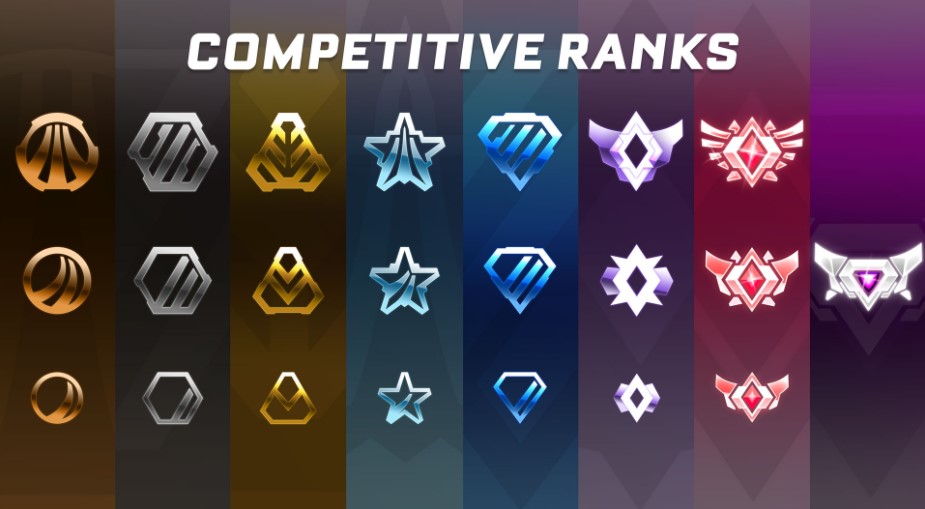
There are no surprises here. The lowest rank in the Rocket League is Bronze. Just like in the scenario with the Fortnite ranks, you will start from Bronze and go up to the Supersonic Legend rank.
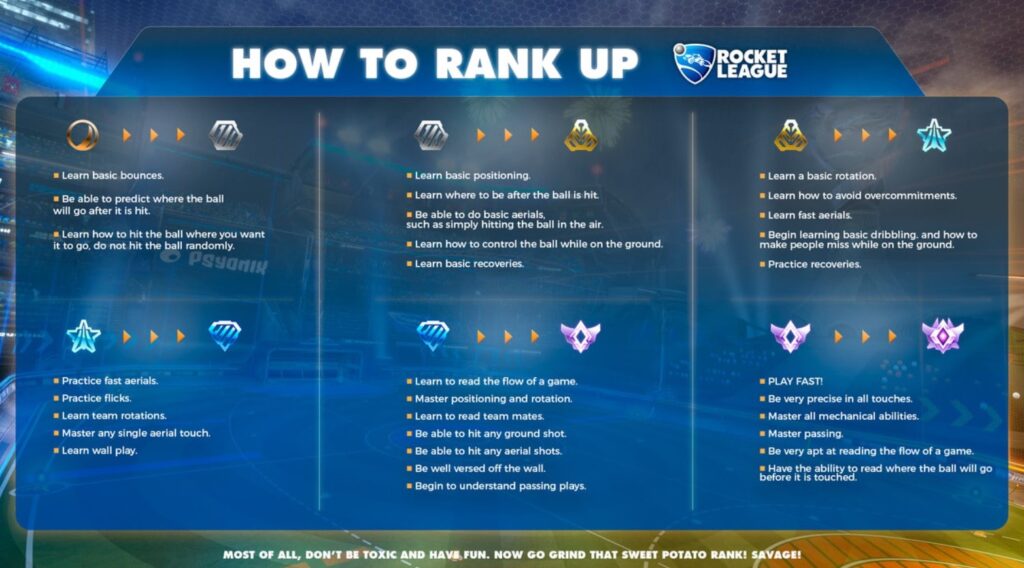
- Bronze (I, II, III). Bronze is where your ranked journey usually begins. At this level, players are still getting comfortable driving, jumping, and bumping the ball. Bronze is about understanding core mechanics, such as staying behind the ball and positioning yourself for a basic shot. Mistakes happen, but it’s all part of the learning curve;
- Silver (I, II, III). Silver is when things start to pick up. Players aren’t just hitting the ball but starting to get used to positioning and rotation a little better. Core mechanics are on autopilot as shots become more consistent and defense works a bit better. The aerials aren’t common, but there’s an understanding that positioning is important to any offense or defense. Silver is where you begin to develop your professional Rocket League instincts;
- Gold (I, II, III). Gold is a big milestone in Rocket League. Players start to feel confident. Aerials are starting to become much more normal. Gold players have a pretty firm grasp of game mechanics. They can make more accurate passes, hit decent aerials, and play with just a little more aggression. Gold is where Rocket League starts to look more like a proper soccer match – teams working together to make plays;
- Platinum (I, II, III). This is where the game really opens up. The players with the Platinum ranks in Rocket League aren’t just comfortable with the basics. Aerial plays become more frequent with players being more eager to make that save or score that goal in the skies. The defense strategy becomes about anticipation rather than pure reaction. Platinum is the level when players begin to make the leap from casual play into really focusing on improving their game;
- Diamond (I, II, III). Diamond-level players are the most dedicated players in Rocket League. At this level, there’s a big jump in quality. Advanced mechanics become important: better aerials, power shots, and wall plays are used. Confidence in rotation by the Diamond players is more assured, trusting teammates to make the plays. The defense is tighter and the offense makes more precise plays. Diamond is a rank where players feel comfortable when controlling the game;
- Champion (I, II, III). Champion is where the elite gameplay starts. Players with such Rocket League ranks have mastered the mechanics fully – they can do aerials with precision, control the ball with ease, and perform complex passes. Rotations are almost flawless and there is a lot of trust between teammates. The gameplay is very fast-moving at this level. Champion is the rank where players shine both as a team and as individual talents;
- Grand Champion (I, II, III). Grand Champion is a dream rank for many Rocket League players. It’s the highest level of competitiveness before one reaches the absolute peak. At this rank, players are almost instinctively in sync with their teammates. The Grand Champion rankers have exceptional control, positioning, and pressure. Flip resets, ceiling shots, and advanced maneuvers are done with ease. There is an incredible amount of skill and deep knowledge of mechanics;
- Supersonic Legend. Supersonic Legend is the highest rank you can achieve in Rocket League. This title is saved for the very, very best players amongst the top 0.03% of the entire player base. This Rocket League rank is where only professionals can compete before going to eSports competitions;
What is MMR in Rocket League?
MMR stands for Matchmaking Rating. Basically, it is the number that’s behind your actual rank in Rocket League. It’s what determines the players the game will match you up against in competitive play. The better you perform, the higher your MMR is. And, logically, the stronger your opponents will be. MMR is the backbone of Rocket League ranks. Also, it impacts the quality of your matches to make sure the players with the same performance level and skills are matched together for playing.
Placement Matches
Placement matches are where your journey with MMR starts. Once you reach level 10, you need to win 10 placement matches for every mode. These matches determine your initial positioning within the ranked ladder. If you win more than you lose, you could start in one rank higher than Bronze, or even higher than Gold and Platinum. If your placement matches go badly, you will start from a considerably lower rank, such as Bronze or Silver. Placement matches are very important since they set the context for your early rank advancement and define your initial MMR.

Changes to MMR
As soon as your initial rank has been determined, MMR focuses on how a player wins or fails. With every match won, MMR increases – with every loss, it decreases. It wins or loses MMR based on the opponent’s relative skill. If you win against a higher-ranked team, you’ll gain more MMR. Respectively, if you lose to a lower-ranked team, the loss will be greater. MMR also takes the margin of victory into account. A close win or loss might result in smaller changes compared to a decisive match.
Rank Thresholds
MMR is related to threshold ranks ranging from Bronze to Supersonic Legend. Each rank has a threshold of MMR, and you need to cross it to get the promotion to the next rank. Similarly, falling below this threshold causes losing a rank. These thresholds build a structured system of ranks in Rocket League where players are constantly competing against each other.

How to Trace Your Rating in Rocket League?
Tracking your progress in Rocket League is key to understanding where you stand and how to improve. While Rocket League does show your rank, your MMR (the hidden number that determines the Rocket League ranks) offers a deep insight into your performance. This is how you can trace your performance and current Rocket League ranks.
Rocket League Ranks Tracker
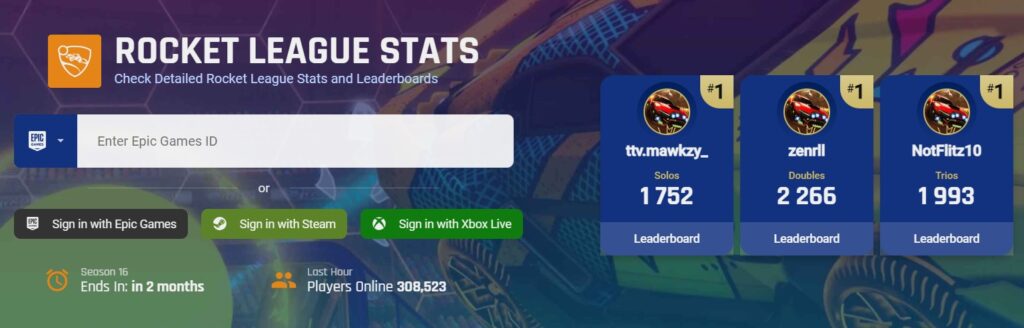
Rocket League itself doesn’t show your MMR until you reach the rank of Grand Champion, but you can use third-party tools to show this information at any rank. The Rocket League Tracker is an online platform where you can view detailed insight into your performance – from your current MMR to your match history and stats for each competitive mode. It helps you to keep a tab on the amount of MMR that you have gained or lost after each match. You can track down your success or placement of your teammates here – Rocket League Ranks tracker.
Leaderboard
The Rocket League Leaderboard shows the best-of-the-best players with the best MMR in each mode – from Standard to Extra. The leaderboard displays the top players in each playlist, from Standard to Extra Modes. Being on the Leaderboard means you’re among the best players in the world. This can be a very motivating thing to keep an eye on.

In-Game Stats
Along with third-party tools, Rocket League offers in-game statistics to track your progress. You can check how many matches you’ve won and what your win percentage is. There are also the stats for goals, saves, and assists. These numbers might prove helpful in defining the strengths and weaknesses.
You can check the following video explaining the nuances of Rocket League ranks.
What Are Rocket League Sideswipe Ranks?
In Rocket League Sideswipe mode, the Competitive Ranks begin with Bronze and move up to Grand Championship. Each Rank has several Divisions, 5 Divisions in each Rank, and different sub-divisions.
Bronze and Silver have 3 sub-ranks for each major rank, Gold and Platinum have 4 sub-ranks (unlike the Competitive mode), while Diamond and Champion have 5 sub-ranks. The Grand Champion works differently by tracking your position on the worldwide Leaderboard based on MMR. Players can’t be demoted out of Grand Champion. Winning matches will promote players into higher Divisions and Ranks while losing more than wins will lead to demotion.
The Rocket League Sideswipe ranks from the lowest to the highest are:
- Bronze;
- Silver;
- Gold;
- Platinum;
- Diamond;
- Champion;
- Grand Champion;
What do you think about the system of Rocket League ranks? Do you want to join the greatest players and play this game to achieve the professional level?
Frequently Asked Questions
Can you play with friends if you have different Rocket League ranks?
You can play with friends who have different Rocket League ranks but with some limitations. In Competitive matches, it is necessary for players in a queue to be within a certain range of each other among ranks. This keeps the matches balanced. However, if you are playing casually, there aren’t any such rank restrictions – you are free to team up with whomever you want. This makes casual a great option for mixed-skill parties.
What MMR is the Champion I in Rocket League ranks?
Well, Champion I in Rocket League will generally take an MMR of about 900 to 1000, depending on the rank distribution of the current season. MMR thresholds can vary slightly since they are based on the skill distribution of the player base. To climb to the Champion I rank actually means that you have a good understanding of the game, including advanced mechanics, consistent rotations, and winning strategies.
What are the Rocket League casual MMR ranks?
Casual mode in Rocket League also has some sort of MMR but they are not as strict as the Competitive ranks. Rocket League’s casual MMR ranks make sure that skillful players are matched against players with equal levels of skills. Unlike the ranks of competitive mode, casual MMR doesn’t tell anything about rewards or seasonal ranks. It is a low-stress environment to improve your skills, try new strategies, or just play with friends of different ranks.
What is the Rocket League Ranks percentage in 2024?
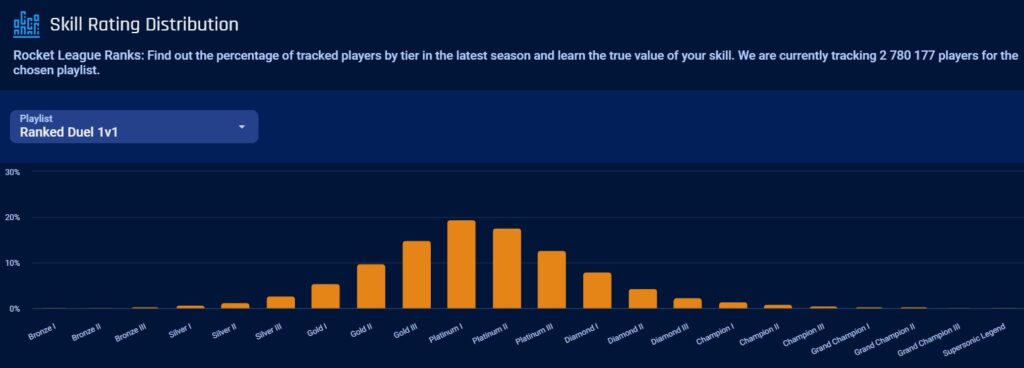
The distribution of Rocket League ranks in percentage in 2024 shows the number of players in all the ranks. During the recent 16th season, most of them have the Platinum and Diamond ranks. The rarest and highest Supersonic Legend accounts are owned only by 0.03% of players.
What is the Rocket League Ranks distribution in the latest season?
The latest season’s rank distribution shows that Platinum and Diamond ranks are the most popular ranks among the players taking part in Competitive matches. Unsurprisingly, less experienced players have Bronze and Silver ranks, with Gold remaining a large stepping stone. Matches above Champion are uncommon, with only a tiny fraction of players making it to Grand Champion and Supersonic Legend. We recommend you read this Reddit thread to get a better picture of the distribution of Rocket League ranks in Season 16.
Conclusion
The system of Rocket League ranks is very fun to explore and use for your benefit if you have dreams about becoming a pro player. Understanding the Competitive mode’s rules, MMR, and the importance of placement matches is what you need to do to start your journey to glory in Rocket League.